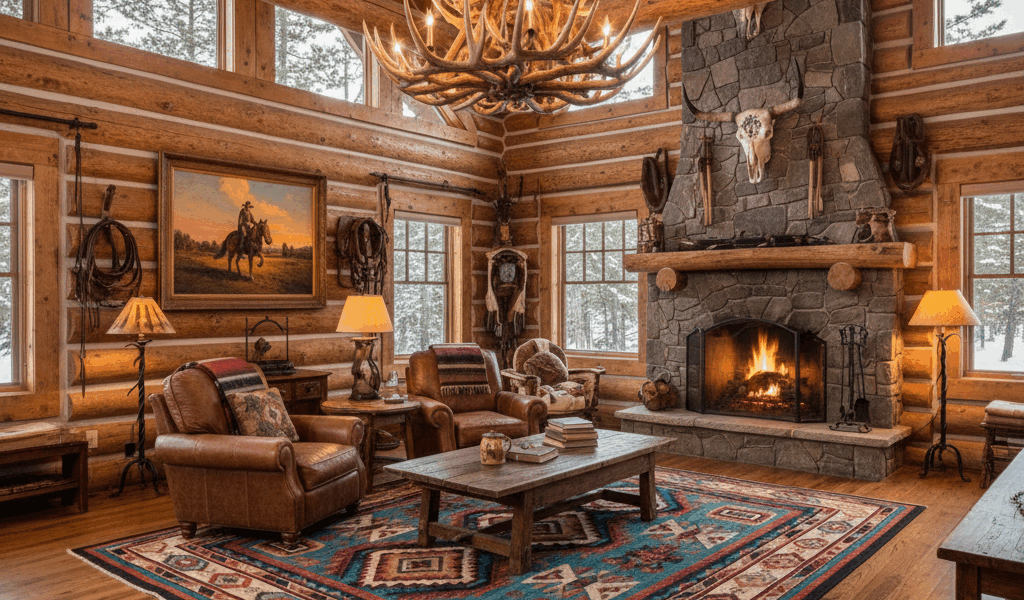
As someone who’s been collecting these pieces for over a decade now, I can tell you that certain design elements have defined rustic cabin style for generations, persisting through every trend cycle while lesser fashions come and go. Antler chandeliers and Navajo textiles occupy this timeless category—not because they’re immune to misuse, but because when done right, they connect log interiors to deep traditions that transcend passing style. I learned everything about these pieces the hard way, making expensive mistakes before understanding what actually works.

The Enduring Appeal of Antler Chandeliers
Antler chandeliers work in log homes for reasons that go beyond rustic aesthetics. Their organic forms echo the natural materials surrounding them. The branching structure fills vertical space without the visual weight of conventional fixtures. And unlike manufactured decor, genuine antlers carry the wild into domestic space—a constant reminder of the natural world beyond cabin walls. That’s what makes these pieces endearing to us cabin owners who value authenticity.
Quality matters enormously. Mass-produced resin imitations fool no one and cheapen every room they occupy. Authentic antler chandeliers, assembled from naturally shed or ethically sourced material, exhibit variations in color, curve, and character that synthetic versions cannot replicate. The investment in genuine antlers pays returns in authenticity that visitors feel even if they can’t articulate why. Probably should have led with this: my first antler chandelier was fake, and I replaced it within a year.
Scale is the most common error. Antler fixtures appropriate for great rooms with soaring ceilings overwhelm standard-height spaces. Conversely, undersized fixtures vanish into vaulted volumes, failing to provide the visual anchor the space needs. Measure carefully. Visualize with painter’s tape and string. Err slightly toward too large rather than too small—antlers read as lighter than their dimensions suggest.
Beyond the Great Room
Antler chandeliers belong in spaces where their scale and presence can be appreciated—great rooms, dining areas, and sometimes master bedrooms with cathedral ceilings. But antler accents extend the theme appropriately throughout the cabin.
Sconces with small antler elements work in hallways and bedrooms. Antler drawer pulls and cabinet hardware bring the motif into kitchens and baths. Individual mounted antlers serve as coat hooks, towel holders, or purely decorative elements. These smaller applications connect secondary spaces to the primary statement without competing with it.
Navajo Textiles: Pattern with Meaning
Navajo weaving represents one of North America’s most sophisticated textile traditions. The geometric patterns carry cultural significance developed over centuries. When you incorporate authentic Navajo textiles into your cabin, you’re participating in a living tradition rather than simply decorating. Choosing Navajo pieces has become harder to navigate with all the reproductions on the market now, but the effort to find genuine pieces rewards you every time you look at them.
Understanding basic pattern categories helps informed selection. Chief blankets feature horizontal bands and simple geometry. Serape-style weavings add diagonal elements. Regional styles from Two Grey Hills, Ganado, and other weaving centers each have distinctive characteristics recognizable to knowledgeable collectors.
Authentic Navajo textiles aren’t cheap. A genuine handwoven rug represents months of skilled labor and generations of transmitted knowledge. The prices reflect this reality. If a “Navajo-style” rug seems too affordable, it’s almost certainly a machine-made imitation from overseas—fine for low-stakes applications but inappropriate for prominent display. I spent three years saving for my first authentic piece, and it remains the most treasured item in my cabin.
Placement and Protection
Navajo rugs demand respectful placement. High-traffic floors wear hand-woven textiles faster than their value justifies. Instead, position prized pieces as wall hangings, furniture throws, or focal points in low-traffic areas. The bedroom beside your bed, the wall behind your sofa, the dining table during special occasions—these placements honor the weaving’s artistic merit while protecting its physical integrity.
Daily-use applications work better with commercial interpretations. Pendleton and other manufacturers produce machine-woven textiles inspired by Southwestern patterns. These pieces bring the aesthetic into practical service—picnic blankets, dog beds, porch furniture throws—without risking irreplaceable handwork.
Combining Elements Thoughtfully
The combination of antler fixtures and Navajo textiles creates a design language that feels specifically American Western, connecting cabins to frontier traditions regardless of actual location. A log home in Maine or Minnesota can incorporate these elements without inauthenticity, because the underlying aesthetic transcends geography.
The danger is overdoing it. A room saturated with antlers, Southwestern textiles, horseshoes, barn stars, and every other rustic cliche becomes costume rather than design. Restraint allows individual pieces to make their statement without visual competition.
Choose a few significant elements and let them breathe. A single spectacular antler chandelier, one prized Navajo weaving on the wall, quality leather furniture, and restraint everywhere else creates impact that cluttered “cabin fever” decorating destroys. Trust me on this—I had to remove half of what I originally displayed before my cabin started feeling like a home rather than a gift shop.
Modern Integration
Contemporary interpretations prove these traditional elements remain vital rather than merely nostalgic. Antler chandeliers with modern LED lighting demonstrate the form’s adaptability. Graphic Navajo patterns appear on pillow covers and throws that bridge traditional and contemporary aesthetics.
The best cabin interiors honor tradition while remaining personal. Your antler chandelier should illuminate your family’s gatherings. Your Navajo textiles should warm your mornings. These aren’t museum pieces preserved under glass—they’re living elements of homes where real life happens.
That continuous use, generation after generation, is precisely why these design elements never go out of style. They’ve earned their place through decades of daily service in cabins across the country.



Stay in the loop
Get the latest rustic cabin world updates delivered to your inbox.