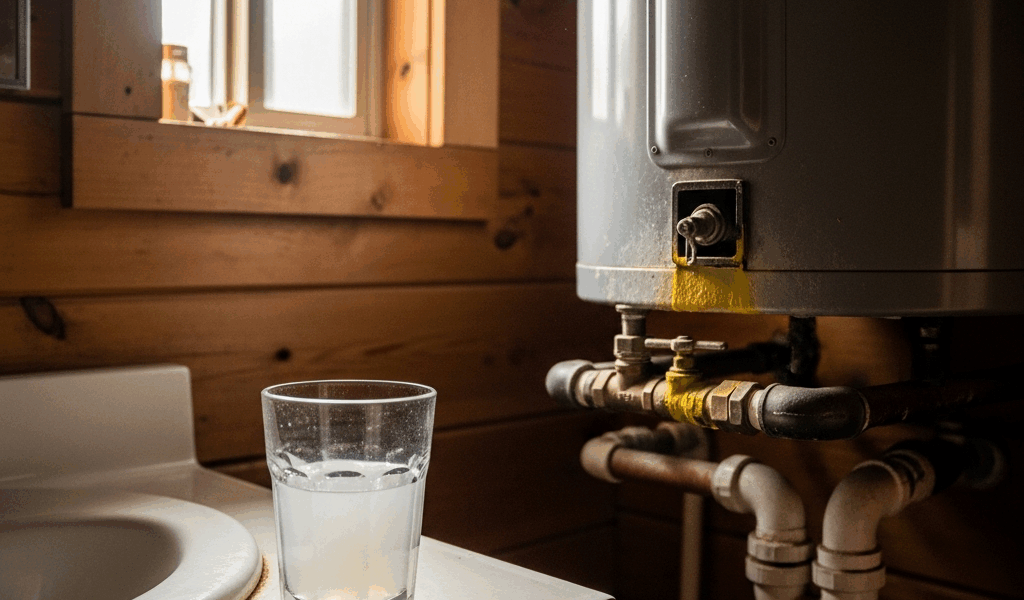
What That Rotten Egg Smell Actually Means
Cabin well water has gotten less clear-cut with all the conflicting advice flying around about sulfur smells, miracle filters, and whether you need to gut your entire plumbing setup. You don’t. As someone who opened their cabin in April to a wall of rotten egg stench so bad I genuinely thought something had died in the walls, I taught myself the working side of hydrogen sulfide in well water. Today, I will share it all with you.
But what is hydrogen sulfide, exactly? In essence, it’s a gas that forms when sulfur compounds react inside your water system. But it’s much more than that — it’s also a diagnostic clue, because where the smell comes from tells you almost everything about what’s causing it.
This article includes affiliate links. We may earn a commission at no extra cost to you.
Here’s the part that surprised me: the EPA doesn’t classify hydrogen sulfide as a health contaminant. It won’t poison your family. What it will do is make your water taste metallic, leave black buildup on your fixtures, and slowly corrode exposed metal pipes. Annoying. Fixable. Not an emergency.
The smell traces back to three distinct sources:
- Your water heater’s anode rod — the sacrificial metal rod inside the tank that corrodes so the tank itself doesn’t have to
- Sulfur-reducing bacteria living in your well casing — harmless microbes that thrive in low-oxygen environments and produce gas as a byproduct
- Natural sulfur compounds in your groundwater — geological sulfur that’s literally baked into your water table
Most cabin owners I know jump straight to draining the well or replacing the water heater. Neither might be necessary. Save yourself the trouble I had. Diagnose first.
Does the Smell Come From Hot Water, Cold Water, or Both
Run this test right now. Five minutes. Eliminates an entire category of causes.
Turn on the cold tap. Run it for 30 seconds. Cup your hand under the stream and bring it to your nose. Sulfur? Note it.
Now the hot tap. Same 30 seconds. Same test. Stronger, weaker, identical?
If the smell only shows up in the hot water: Your water heater is the culprit. The anode rod inside is reacting with sulfate in your water and producing hydrogen sulfide gas. This is by far the most common cause in older cabins — especially those with water heaters that have been sitting five years or longer without much use. That was my situation exactly, April 2019, a five-year-old Rheem tank that had stagnated all winter.
If the smell is in both hot and cold water: The source is your well itself. Either sulfur-reducing bacteria have colonized your well casing, or there’s natural sulfur in your groundwater. The water heater isn’t involved at all — replacing it would accomplish nothing.
If it’s mostly in the cold but faintly present in hot: Probably a well issue, but some of that heated water has picked up residual odor from corroded pipes or fixtures. Run the hot tap for two full minutes and retest. If the smell clears, you’re primarily dealing with a well problem.
That’s what makes this simple diagnostic so endearing to us cabin owners — one five-minute test, and you’ve already ruled out half the possible causes.
How to Fix It When the Water Heater Is the Culprit
Worth saying out loud. The anode rod swap is the most common fix and the most DIY-friendly repair on this list.
You have two rod options: magnesium or aluminum. Magnesium rods are original equipment in most tanks — and they’re the ones prone to creating sulfur smell when your groundwater contains sulfate. Aluminum or zinc-aluminum hybrid rods skip that reaction entirely. Swap one for the other. No other system changes needed.
While you won’t need specialized plumbing tools, you will need a handful of basics: a socket wrench set, a garden hose, a bucket, and about 45 minutes. Here’s the process. Drain the tank completely using the valve at the bottom — attach a hose and run it somewhere appropriate. Once empty, locate the anode rod. It’s usually a hex-head bolt recessed into the top of the tank, often under a plastic cap. A 1-1/16-inch socket typically fits. The rod will likely come out encrusted with sediment and corrosion. That’s normal. That’s what it’s supposed to look like after doing its job.
Drop in the replacement aluminum rod — I used a Corro-Protec powered anode on my second cabin and it’s been three seasons without a hint of smell. Hand-tighten, snug it down with the wrench, refill, run the hot tap for two minutes to flush sediment.
The rod itself costs $30 to $75 depending on tank diameter and length. A plumber will charge $200 to $400 for the same job. I’m apparently stubborn about DIY repairs and the aluminum rod swap works for me while calling a plumber for basic maintenance never quite feels justified. Your call.
Smell should be gone within 24 hours of replacement. If it lingers, you’ve got a secondary well issue.
When the Smell Is Coming From Your Well
Sulfur-reducing bacteria love exactly the conditions a seasonal cabin creates: low oxygen, minimal water movement, months of dormancy. Spring thaw especially concentrates the problem. Shallow wells are higher risk — anything under 100 feet tends to see this more than deep-drilled systems.
Shock chlorination might be the best option, as well bacteria treatment requires actually killing the colonies rather than just filtering around them. That is because the bacteria will keep reproducing and producing gas regardless of what filters you put downstream. A well service company injects high-concentration chlorine solution directly into the casing, lets it sit 8 to 24 hours, then flushes the system completely. Cost runs $200 to $500 depending on well depth and your county. Many cabin owners handle this themselves — your county health department will have instructions specific to your well type and depth.
Frustrated by recurring smell after two shock treatments in the same summer, a neighbor of mine finally paid for a proper water test using a $45 kit from a certified lab. Results came back showing naturally elevated sulfur in the groundwater itself — not bacterial at all. That changed everything about the fix he needed.
If the smell returns within weeks after chlorination, you’re probably dealing with geological sulfur. Permanent feature of your water table. This new reality means a whole-house filter system, and eventually evolves into the solution cabin owners in sulfur-rich areas know and rely on today. Sediment pre-filters paired with sulfur-specific catalytic carbon cartridges handle most of the odor load. Systems run $800 to $1,500 installed — more common in areas with known sulfur aquifers, which explains why your cabin might need one while your neighbor’s identical property on the other side of the ridge doesn’t.
Preventing the Smell From Coming Back Each Season
Flush your water heater every single time you open the cabin. Drain three to five gallons from the bottom spigot before you do anything else. This clears the sediment layer that concentrates hydrogen sulfide production over months of non-use. Takes ten minutes. Saves you the April surprise.
Inspect the anode rod every two to three years — or every season if your water has high sulfate content. A rod thinned down to the wire core needs replacing even if there’s no smell yet. Prevention beats reaction every time.
First, you should get a basic water test done — at least if you’ve had recurring smell issues that don’t resolve with simple rod replacement or shock chlorination. Knowing your sulfate levels and whether bacteria are actually present changes every decision that follows.
So, without further ado, let’s be direct about the bottom line: the hot-versus-cold diagnostic takes five minutes and tells you exactly which fix you need. Do that first. Then spend money on exactly one solution — not three.



Stay in the loop
Get the latest rustic cabin world updates delivered to your inbox.