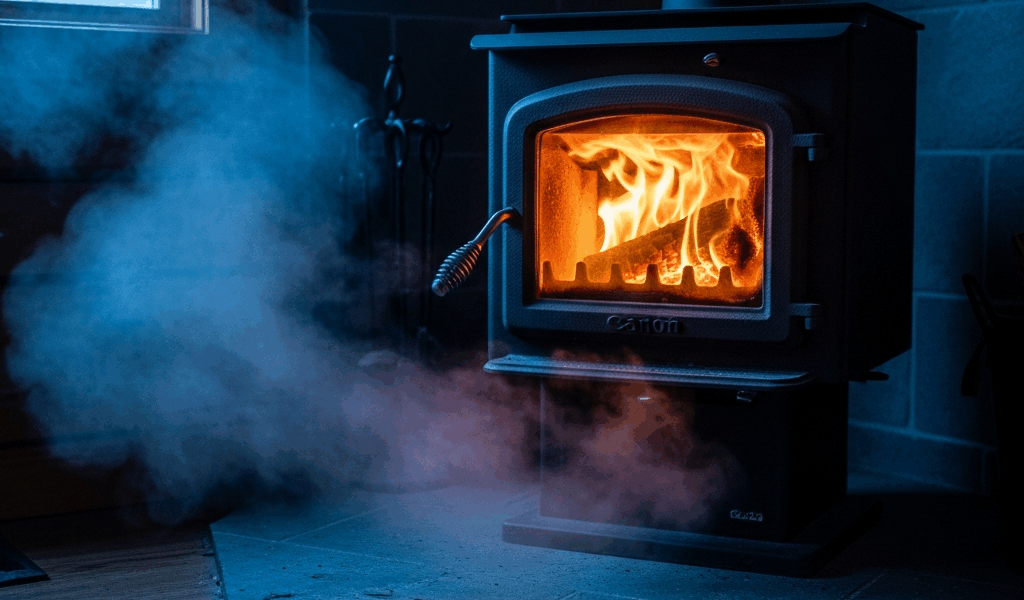
Why a Hot Fire Does Not Always Mean a Warm Cabin
Cabin heating has become tricky with all the conflicting advice flying around. You’ve got a firebox glowing orange-red. Heat radiates off the glass so intensely you can feel it from across the room. And yet — there you are, ten feet away, still wearing a fleece, staring at a thermostat stuck at 55 degrees. Maddening doesn’t quite cover it.
But what is the actual problem here? In essence, it’s the difference between combustion heat and room heat. But it’s much more than that. A stove can burn genuinely hot — 70,000 BTUs of hot — and still leave you shivering if that energy rockets up the chimney, seeps through gaps, or never circulates into the space where you’re actually sitting. This isn’t a fire problem. It’s a distribution problem. That distinction matters enormously.
So, without further ado, let’s dive in — starting with what you control most directly, then moving outward to airflow, the room itself, and finally the uncomfortable question of whether your stove was ever the right size to begin with.
Start Here — Wood Quality and How You Are Loading It
This is the first thing I check when someone tells me their stove isn’t performing. Honestly, it solves things roughly 60 percent of the time. Which probably means most people never needed to call anyone in the first place.
Wet wood kills stove output faster than any other single factor. Green or freshly cut wood can carry 50 percent moisture by weight. All that water has to boil off before combustion gets efficient — meaning you’re spending real energy evaporating moisture instead of heating your cabin. Properly seasoned hardwood, split and stacked under cover for 12 to 18 months, drops to around 15 to 20 percent moisture content. The BTU difference is staggering. We’re talking roughly 3,500 BTUs per cord from green wood versus 8,000 to 9,000 from seasoned hardwood. Same fire. Radically different output.
There’s a quick field test. Split a piece from your pile and look at the exposed end. Still light-colored with almost no darkening in the grain? Too wet. Seasoned wood shows visible darkening at the split end and usually surface checking — those small radial cracks across the end grain that look like a dried mud flat. No amount of damper adjustment fixes wet wood. Steer clear of where I went wrong of spending a winter diagnosing the wrong thing.
The second issue is overloading. I learned this one the hard way in my own cabin — I thought more wood meant more heat. It doesn’t. Cramming logs in smothers the fire. Oxygen can’t circulate. The burn drops to a smolder, efficiency craters, and you get creosote building up in the flue as a bonus. Load the stove to about three-quarters capacity. Flames should be visibly dancing around the wood, not buried beneath a pile of logs with nowhere to go.
Start with seasoned hardwood — oak, maple, ash, hickory are all solid choices. Split pieces to roughly 3 to 4 inches wide. Load moderately. If the cabin is still cold after fixing those two things, move to the next section.
Check Your Airflow — Damper, Draft, and Door Seal
A wood stove needs oxygen in and a clear exhaust path out. Mess with either one and heat escapes before the room ever captures it. That’s what makes airflow so frustrating to diagnose — the fire can look perfectly fine while silently hemorrhaging efficiency.
Start with the damper. Most cabin stoves have a handle on the door or a lever on the stove body — this controls both air intake and how fast exhaust exits. For maximum heat output, keep the damper fully open while you’re building coals. Once you have a solid coal bed established, you can close it partway to extend burn time. But closing it too early — or too far — restricts draft and pulls heat up the chimney instead of into the room. I’ve watched people lose a third of their stove’s effectiveness just from damper habits.
Test your draft with a piece of tissue. Light the fire, crack the stove door an inch, and hold the tissue near the gap. Good draft pulls the tissue toward the stove. If it flutters weakly or drifts away, you have a draft problem worth investigating.
Poor draft often traces back to the door gasket — that rubber seal running around the stove door. Frustrated by a stove that seemed to perform worse every season, I finally pulled mine apart using a flashlight and a straightedge and found a gasket so compressed it had basically stopped functioning. After years of thermal expansion and contraction, it had hardened and shrunk, letting uncontrolled air leak in during the burn cycle. Replacement runs $15 to $40 depending on your model and takes maybe 30 minutes. Most hardware stores can order the right one if you bring your stove’s model number. That fix alone can recover 10 to 15 percent of heating capacity.
Altitude and outside temperature matter more at cabins than in lowland homes. Cold, thin air at 7,000 feet doesn’t draft as forcefully as sea-level air. Nights below zero can slow draft significantly unless the chimney is well-insulated. If your cabin sits high and cold, damper management during deep winter needs more attention than most stove guides suggest.
The Room Itself May Be the Problem
Quick note before the rest of this — because sometimes the stove is doing everything right and the room is simply working against it.
Cabin heat loss runs deeper than in typical homes. Single-pane windows bleed warmth constantly. Log walls develop settling gaps over the years. Most critically, cabins tend toward high ceilings and open loft spaces that pull warm air upward — away from where anyone’s actually sitting. The stove heats the ceiling beautifully. You, meanwhile, are cold.
Here’s a fix that costs almost nothing: run a ceiling fan on low, set to push air downward. Warm air rises naturally — a fan circulating it back into the living zone makes a genuine 5 to 10 degree practical difference. I installed a $29 Hunter 52-inch fan in my cabin loft last December and immediately stopped feeling like I was heating empty space above my head. That was the whole fix. One afternoon, one fan, done.
Open floor plans and vaulted ceilings also require significantly more stove output than raw square footage suggests. A 1,200-square-foot cabin with 14-foot ceilings and single-pane windows needs meaningfully more heating capacity than a 1,200-square-foot cottage with 8-foot ceilings and double-pane glass. The exposed surface area and thermal losses aren’t even close. Don’t let square footage math mislead you.
When the Stove Itself Is Too Small for the Space
If you’ve fixed the wood quality, addressed the damper and door seal, added circulation, and you’re still cold — the stove may simply be undersized. This is the answer nobody wants, but it’s sometimes the only honest one.
Standard sizing rules float around 5 BTU per square foot for well-insulated homes in moderate climates. Cabins don’t fit that category. For a poorly insulated cabin in a genuinely cold climate, budget 8 to 10 BTU per square foot at minimum. A 1,000-square-foot cabin might need 8,000 to 10,000 BTUs. Most small cabin stoves — the kind designed to fit a modest hearth — max out somewhere between 55,000 and 65,000 BTUs. If you’re trying to heat a large open space with a stove sized for a den, you may have been undersized from day one.
The signal is clear enough: you’re doing everything right operationally, the fire burns clean and hot, and the room stays cold regardless of what you do. That’s a sizing mismatch, not a performance failure. Stove sizing calculators and manufacturer BTU ratings are your next step. And don’t assume the stove that came with the cabin was correctly chosen — I’m apparently allergic to assuming previous owners did their homework, and that skepticism works for me while blind trust never does.


Stay in the loop
Get the latest rustic cabin world updates delivered to your inbox.