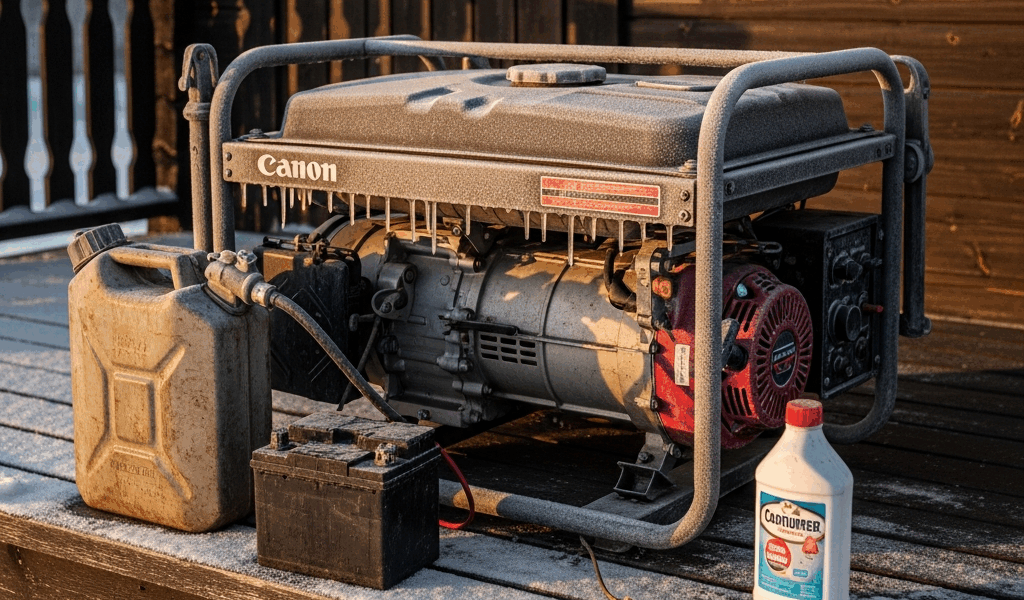
Why Cold Weather Kills Generator Starts
Generator troubleshooting in winter has gotten complicated with all the conflicting advice flying around. As someone who’s yanked a starter cord at 6 a.m. in February outside a frozen cabin, I learned everything there is to know about cold-weather generator failures. Today, I will share it all with you.
Cold doesn’t just inconvenience your generator — it attacks from three directions at once. First, the oil thickens. That synthetic 10W-30 that poured fine in October? At twenty below, it’s closer to cold butter than motor oil. Your pistons are fighting through it before combustion even happens. Second, fuel separates. Ethanol-blended gas — which is basically all gas sold in the U.S. now — absorbs moisture while it sits. Leave it in the tank from September to January and you’ve got water mixed in. Temperatures drop, that water freezes, and suddenly the carburetor is trying to pull slush. Third, the battery is already compromised before winter adds anything. Five months of sitting without a charge cycle does real damage. Cold just finishes the job.
Those three problems point you directly at where to start looking. You’re not fixing all of them simultaneously. You’re eliminating the obvious stuff first — then going deeper.
Start Here Before You Touch Anything Else
Most cold-weather generator failures come down to checks that take under thirty seconds. Probably should have opened with this section, honestly.
Check the choke. Manual chokes — standard on most portable units — need to be in the full cold position before a cold start. Usually marked with a snowflake or labeled “Cold.” Pull it all the way. If the previous owner left it mid-position, the engine won’t get enough fuel to fire. Move it, try the cord again.
Verify the fuel valve is actually open. I’ve done this — sat there freezing, convinced the generator was dead, while the shutoff valve under the tank had been closed since October. It’s a small lever on the underside of the fuel tank. Perpendicular to the fuel line means open. Parallel means closed. Check it before anything else.
Look at the low-oil shutoff sensor. Generators won’t start if the oil level is too low — there’s a safety sensor that kills the ignition. Even if you topped it off last fall, oil settles. Pull the dipstick, wipe it, reinsert, and check the level. If it’s low, add the correct winter-grade oil — most small engines want SAE 10W-30 for cold climates, not straight 30-weight. Add a quart, try the starter again.
Test whether the battery has any charge left. The pull-start cord should feel normal — not stiff, not weirdly loose. Mushy recoil usually means the battery is gone. Try switching on any electrical feature your model has. Nothing? Dead battery. Put it on a 12-volt charger for eight to twelve hours before you touch the starter again.
These four checks solve roughly 70 percent of cold-start failures. If the generator fires after one of them, you’re done. If not, fuel and carburetor territory is next.
Fuel Problems That Show Up in Winter
Gasoline does not age well sitting in a cold shed.
But what is ethanol-blend phase separation? In essence, it’s what happens when the ethanol in standard pump gas absorbs ambient moisture over several months, then separates from the gasoline itself into a water-ethanol layer sitting at the bottom of your tank. But it’s much more than a chemistry inconvenience — when temperatures drop below freezing, that layer freezes inside the fuel line or carburetor. The engine tries to draw frozen slush. It won’t start.
The fix is brutally simple. Drain it and replace it.
Open the fuel valve. Find the drain plug or fuel line at the base of the tank — your manual will show the exact spot on your model. Position a small container underneath, pull the plug, and let the old fuel drain completely. Discard it at a fuel recycling station. Don’t pour it on the ground or down the drain.
Close the drain plug. Fill the tank with fresh gasoline and add a dose of fuel stabilizer — Sta-Bil 360 or Sea Foam both work well, roughly one ounce per gallon. Run the generator for ten to fifteen minutes so the fresh fuel cycles completely through the carburetor. That stabilizer prevents phase separation for the next storage season.
Try the starter. A lot of generators fire right up once you’ve swapped stale fuel for fresh. If it still won’t start, varnish buildup inside the carburetor is probably the next problem.
Oil Viscosity and the Cold Start Problem
Frustrated by a generator that barely turned over last January, I finally pulled the dipstick and realized I’d been running straight SAE 30 oil since July. That was my entire problem.
Straight-weight 30 oil becomes nearly gelatinous in subfreezing temperatures. The starter motor fights against an engine that feels packed with cold molasses — drawing maximum amperage just to rotate the crankshaft. Even a fully charged battery drains fast under that load. The engine barely spins. It never fires.
Check your generator’s manual for the recommended cold-weather viscosity. Most small engine manufacturers specify 5W-30 or 10W-30 for winter operation — the “W” number indicates viscosity at cold temperatures, and lower numbers mean thinner oil when cold. I’m apparently a 10W-30 person and that grade works for me while straight 30-weight never does once November hits. Don’t make my mistake.
Drain the existing oil completely. Most portable generators — the Honda EU2200i, the Westinghouse WGen7500, most Briggs-powered units — have a drain plug on the underside of the engine block. Set a drip pan, pull the plug, and wait. Old oil usually runs darker. Let it drain fully, wipe the plug threads, reinstall. Fill to the dipstick line with the correct winter-grade oil.
While it’s draining, look at the color. Dark brown or black means the oil was overdue for a change regardless of the season. Light amber means it’s fresh enough — just the wrong weight.
Switch to winter-grade, try the starter, and listen. The engine should crank noticeably more freely. If it starts, run it for a few minutes, recheck the oil level, and top off if it’s settled below the line.
If It Still Won’t Start — Carburetor and Next Steps
At this point, a dead battery, frozen fuel, and thick oil are all off the table. The carburetor is almost certainly the problem.
Varnish is what kills carburetors during storage. Gasoline oxidizes over months and leaves sticky, lacquer-like deposits on the tiny jets and passages inside the carb body. Cold temperatures make those deposits harder — more resistant to fuel flow, more likely to block the circuit entirely.
Spray carburetor cleaner directly into the intake while the fuel valve is closed. You can usually reach it from the top of the engine or from the fuel line side — use the straw attachment that comes with most spray cans. Five to ten seconds of spray, let it soak for a full minute, repeat three times. That’s a field test more than a repair. If the generator fires up immediately, varnish was blocking the circuit and you’ve temporarily cleared it.
If the cleaner doesn’t get it running, you’ve got two options. First, disassemble and clean the carburetor yourself — this requires a small engine rebuild kit (usually $8–15 on Amazon for most common carb models), a set of small-tip screwdrivers, and patience. Second, take it to a small engine shop. Most independent shops charge $75–150 for a carburetor cleaning. That’s worth it if this isn’t your kind of work.
While you won’t need a full machine shop, you will need a handful of basic tools and some mechanical confidence to tackle the carburetor yourself. That said, next fall is when this problem actually gets solved. Run the generator dry at the end of the season — under no load until the tank and carb are both empty. Or fill the tank, add stabilizer, and run it for fifteen minutes. Store the battery on a trickle charger. Do those two things and your generator won’t be giving you this same conversation next January.




Stay in the loop
Get the latest rustic cabin world updates delivered to your inbox.