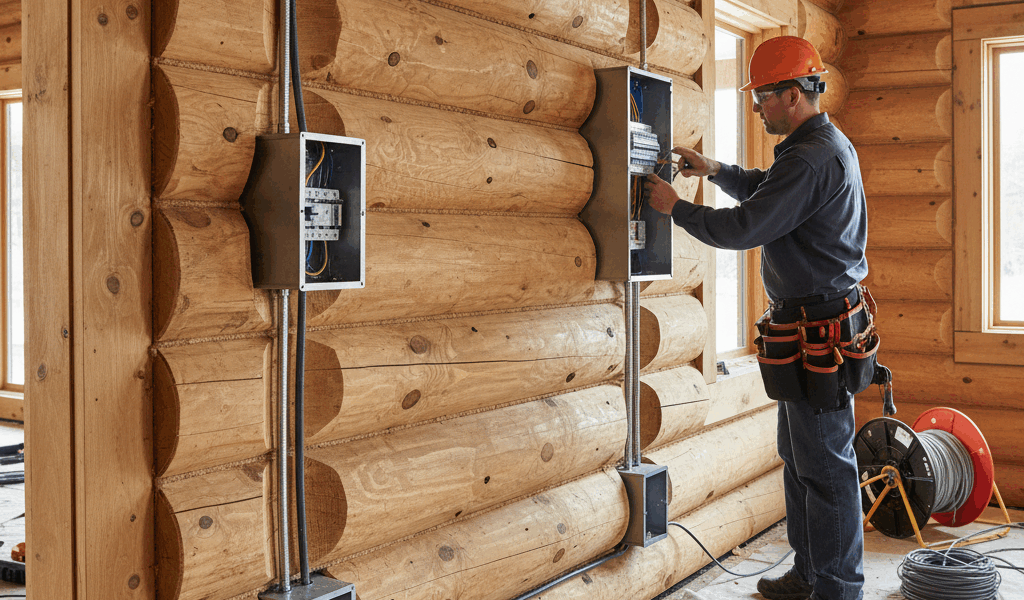
As someone who watched an electrician scratch his head for three hours before admitting he’d never wired a log home, I can tell you that wiring a log home seems straightforward until you actually try to do it. Electricians who’ve never worked with log construction routinely underestimate the challenges involved, leading to code violations, aesthetic disasters, and costly rework. I learned everything the hard way, and understanding what makes log home electrical different can save you from the same mistakes.

The Fundamental Problem: Logs Are Solid
Conventional stud walls offer convenient cavities for running wire. The electrician drills through top plates, drops Romex between studs, and installs boxes at predictable locations. The wall itself is essentially hollow, designed to accommodate wiring.
Log walls are solid wood—eight to twelve inches of it. There are no convenient cavities. You can’t drill from above and fish wire down. Every outlet, switch, and light fixture requires a specific plan for getting wire from point A to point B through dense material that doesn’t want to be disturbed. Probably should have led with this: if your electrician doesn’t immediately understand the problem when they see your log walls, find a different electrician.
Electricians accustomed to standard construction often don’t grasp this reality until they’re standing in your cabin holding a drill and realizing their normal approach won’t work. That’s exactly the wrong time for this revelation—and exactly what happened to me.
Planning During Log Selection
The ideal time to address electrical routing is during the log package design phase. Many manufacturers offer logs with pre-drilled wire chases—vertical bores running through the log cores at specific locations. These chases provide pathways for wire runs without any visible channels or surface-mounted conduit.
If pre-drilled chases aren’t available, coordinate with your builder to drill pathways during wall assembly. Planning log home electrical has gotten complicated with all the modern requirements, but it’s vastly easier to drill through individual logs before they’re stacked and sealed than to bore through an assembled wall.
Outlet and switch locations should be determined before a single log is placed. Moving an outlet three feet left is trivial in conventional construction and potentially impossible in log work without visible modifications.
Interior Wall Options
Interior partition walls present opportunities. These walls are typically conventional stud construction even in log homes, providing the cavities needed for standard wiring practices. Smart design routes as much wiring as possible through interior partitions, minimizing the electrical demands on exterior log walls. That’s what makes thoughtful planning endearing to us log home owners.
Concentrate fixtures requiring power on interior walls when possible. A kitchen designed with the sink and range on interior partitions and only windows on the log exterior wall is far easier to wire than one requiring multiple outlets along log surfaces.
Dealing with Existing Log Walls
Retrofit electrical work in existing log cabins requires creativity. Surface-mounted conduit is the most common solution, running wire in metal or PVC raceways along the wall surface. When done thoughtfully—following log contours, using coordinating colors, positioning at floor or ceiling lines—conduit can be reasonably unobtrusive.
Some installers route conduit behind furniture lines where it will be concealed. Others use floor-mounted outlets with in-floor wiring, eliminating wall runs entirely for certain applications. We ended up using a combination of these approaches.
Wireless technology increasingly offers alternatives. Smart switches that communicate wirelessly need only power at the fixture location, eliminating the need to run switch legs through log walls. Battery-powered sensors and controls require no wiring at all.
Code Compliance Challenges
Log construction creates specific code compliance issues that inspectors may not understand. Wire protection requirements, box mounting specifications, and ground fault protection rules all apply, but the methods for meeting them differ from standard construction.
Work with an electrician who has documented log home experience, and consider having them communicate with your local inspector before work begins. Establishing mutual understanding of acceptable methods prevents unpleasant surprises during inspection. I learned this after a failed inspection that cost us two weeks.
Some jurisdictions require armored cable (MC or AC) rather than standard Romex in log applications. The steel jacket provides mechanical protection when wire runs through bored holes where future settling could create pinch points.
Settling Considerations
New log homes settle as the wood dries and compresses under the building’s weight. This settling—sometimes several inches over the first few years—affects electrical installations. Wire runs must include service loops that accommodate this movement without stressing connections or pulling loose from boxes.
Vertical runs through settling log walls require special attention. The wire needs slack to accommodate shortening as logs compress. Rigid installations that assume static dimensions will fail as the building moves.
Finding the Right Electrician
The electrician who wired your neighbor’s ranch house may not be qualified for log work. Ask specifically about log home experience. Request references from log homeowners, and verify those references. The learning curve for log electrical work is steep, and you don’t want to finance someone’s education. Trust me on this—I made that mistake once.
Log home builders often maintain relationships with trade contractors who understand log-specific requirements. Your builder’s recommended electrician may not be the cheapest option, but the premium typically reflects genuine expertise worth paying for.

Stay in the loop
Get the latest rustic cabin world updates delivered to your inbox.