Updated January 2026 | Based on energy audits from two Colorado log home builders
The log home industry has a dirty secret: solid log walls have an R-value of only about R-1.25 per inch of thickness. A typical 6-inch log wall is R-7.5 – far below code requirements in most states.
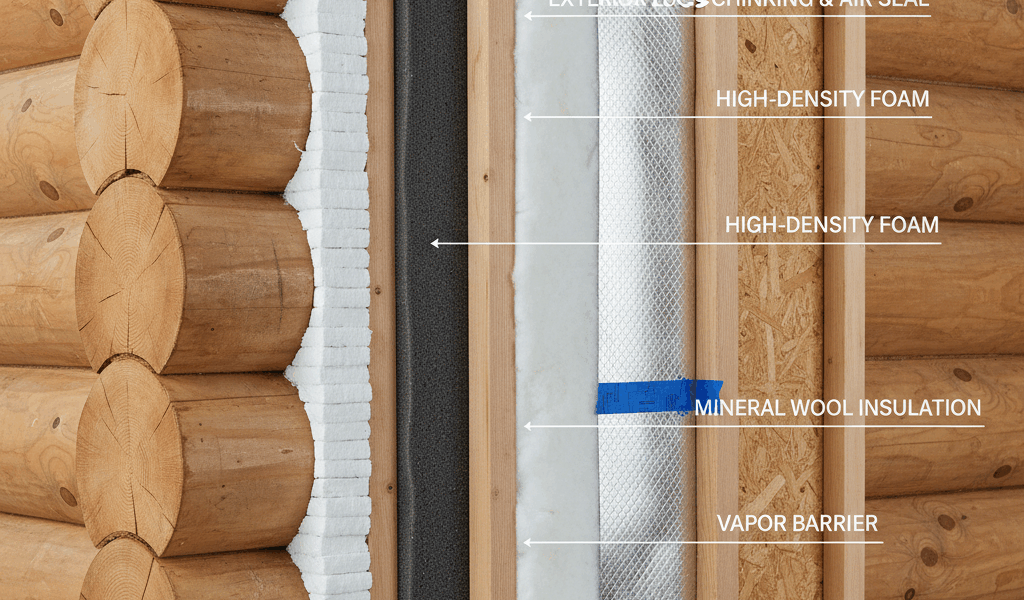
Builder Quote: “We stopped building solid log walls in 2018. Now we do log-on-frame with 2×6 stud walls and R-21 insulation behind a 3-inch log shell. Same look, triple the insulation.” – Dave Richardson, Summit Log Homes, Breckenridge CO
Where to actually insulate: Roof/ceiling (R-49 minimum at altitude), floor over crawl space (R-30), and any interior frame walls. Chinking and sealing log joints matters more than wall R-value for air infiltration.
The insulation question in log homes generates more confusion and misinformation than almost any other building topic. Conventional builders insist log walls are thermally inferior. Log home purists claim solid wood needs no additional insulation. The truth, as usual, falls somewhere between these extremes—and understanding where requires digging into how log walls actually perform.

The R-Value Myth
Standard insulation conversations focus on R-value—the measure of thermal resistance. Fiberglass batts come with printed R-values. Spray foam installers quote R-values per inch. Building codes specify minimum R-values for wall assemblies. By this metric, log walls appear hopelessly inadequate.
A six-inch solid log wall achieves approximately R-8 to R-10, depending on wood species and moisture content. Modern energy codes often require R-21 or higher for exterior walls. On paper, log homes fail miserably.
But R-value only measures one aspect of thermal performance. It ignores thermal mass entirely, and thermal mass is where log walls shine.
Understanding Thermal Mass
Thermal mass describes a material’s ability to absorb, store, and release heat energy over time. Massive materials—stone, concrete, solid wood—moderate temperature swings by absorbing excess heat during warm periods and releasing it during cool periods.
Log walls function as thermal batteries. On a sunny winter day, the interior surface absorbs heat from your wood stove, storing that energy within the wood itself. As evening temperatures drop, the logs slowly release stored heat back into the living space. This release continues through the night, maintaining more stable temperatures than lightweight insulated walls could achieve.
Studies comparing actual energy consumption in log homes versus stick-built homes with equivalent R-values consistently show log homes performing better than R-value calculations predict. The National Bureau of Standards found that log homes in moderate climates performed as well as conventionally insulated homes despite dramatically lower R-values.
When Additional Insulation Makes Sense
Regional climate determines whether supplemental insulation is necessary. In moderate climates—roughly USDA zones 5-7—properly built log walls often need nothing beyond the solid wood itself. The thermal mass benefits compensate for lower R-values.
Extreme cold changes the equation. In northern Minnesota, Montana, or Alaska, the temperature differential between inside and outside is so severe that thermal mass alone cannot maintain comfort without excessive fuel consumption. These regions genuinely benefit from additional insulation strategies.
Extremely hot climates present different challenges. If air conditioning is your primary energy expense, thermal mass provides less benefit. Hot climates favor high R-value assemblies that simply block heat transfer rather than managing it over time.
Insulation Options for Log Homes
If additional insulation is warranted, options exist that preserve log aesthetics. Interior half-log siding over conventional stud walls provides the log appearance with standard insulation behind it. This approach is common in extremely cold regions where true solid log walls would require impractical thicknesses.
Insulated log systems sandwich rigid insulation between interior and exterior log shells. The thermal break dramatically improves R-value while maintaining authentic log surfaces on both sides. These systems cost more than solid logs but perform better in extreme climates.
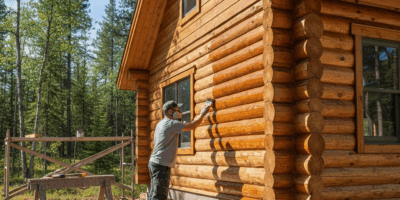
Chinking and sealing improvements often provide more benefit than adding insulation. Air infiltration accounts for significant heat loss in log homes. Ensuring tight joints, quality chinking, and properly sealed penetrations can improve performance without touching the wall assembly itself.
The Roof and Floor Matter More
Before worrying about log wall insulation, address the roof and floor assemblies. Heat rises, making ceiling insulation critically important. R-49 or higher in the roof assembly is appropriate for most climates. This investment pays back faster than any wall modification.
Floor insulation is similarly important if your cabin sits over a crawl space or unheated basement. Cold floors create comfort problems that no amount of wall insulation can solve. R-30 under the floor is a reasonable minimum for most applications.
Making Your Decision
Resist the urge to apply conventional building logic to log construction. Your cabin isn’t a poorly insulated stick-built house—it’s a fundamentally different building system with its own performance characteristics.
For most log cabin applications in temperate climates, solid log walls perform admirably without modification. Focus your insulation budget on the roof and floor assemblies. Invest in quality doors and windows. Ensure tight construction throughout. These improvements deliver better returns than chasing R-values in your log walls.



Stay in the loop
Get the latest rustic cabin world updates delivered to your inbox.