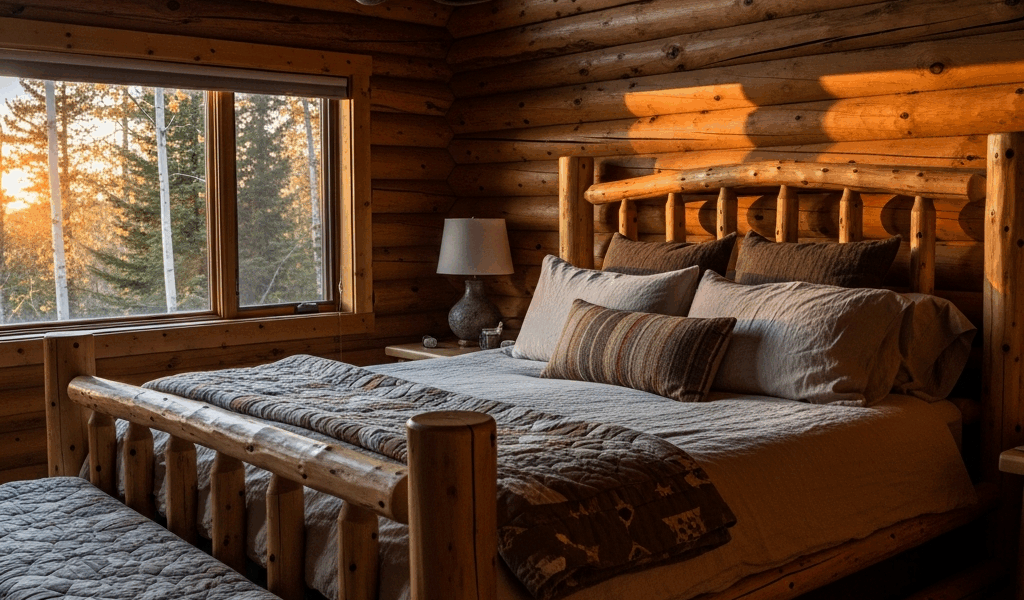
You have the log walls. You have the view. But the bedroom still feels like it belongs in a subdivision with a pine-scented candle on the nightstand. I have been there — staring at a perfectly fine room in a cabin that just does not feel right. The issue is almost always in the details: the bed frame, the lighting, the textiles. Fix those three things and the room stops being a bedroom with wood walls and starts actually feeling like a cabin.
The Foundation: Bed Frame and Headboard Choices That Define the Look
The bed frame sets the entire tone. Get this one piece right and everything else falls into place around it. Get it wrong and no arrangement of throw pillows saves the room.
Three categories of frames actually read as cabin. Log bed frames — full log construction with rounded edges, lodge style — make the most dramatic statement. Pine, cedar, or fir are the classic cabin woods. Each shows visible grain and natural knots that furniture manufacturers usually sand away and hide. Real Log Furniture and Montana Reclaimed Lumber both produce solid pieces if you cannot find a local builder who works in log furniture. My personal preference is cedar for the durability, though pine costs less and looks just as authentic.
Reclaimed wood platform beds hit a different note — a flat plank headboard built from rough-sawn lumber. Less lodge, more modern cabin. The texture and age of the wood does all the heavy lifting. These are particularly good in smaller bedrooms where a full log frame would eat up visual space and make the room feel cramped.
Wrought iron bed frames in a dark patina finish go the opposite direction entirely. They feel like something your grandmother kept at the lake house for forty years. Clean dark lines, and they pair beautifully with quilts and wool blankets. The iron lets the wall behind the headboard become the statement instead of the bed itself.
The one trap to avoid: mass-market “rustic” furniture from big retailers built on MDF with a wood-grain veneer. It photographs acceptably for a listing and reads as immediately fake in person. The grain pattern repeats, the edges are unnaturally perfect, and the weight gives it away the first time you move it. Real wood costs more. It is also the difference between a cabin bedroom and a themed hotel room at a ski resort.
Color Palette: Earthy Tones That Work With Natural Wood
Walls, bedding, and accent pieces should reinforce the natural wood in the room. Not compete with it. This is where cabin bedrooms go sideways most often — someone picks a color they love without checking whether it fights the warm wood tones already dominating the space.
For wall paint, stay warm. Benjamin Moore White Dove gives you a warm white that bounces light without going sterile. Sherwin-Williams Alabaster runs slightly creamier. If you want actual color, SW Evergreen Fog is a muted sage green that pairs beautifully with pine and cedar walls, and BM Pale Oak provides a warm tan that practically vanishes against lighter wood tones. All four are safe picks that I have seen work in cabins across different wood species and stain levels.
The guiding rule: avoid cool grays and blues on the walls. They fight warm wood tones every single time. A blue-gray accent wall in a log cabin bedroom creates visual tension where the cool paint and the warm logs argue — and neither wins. Save the blues for a coastal house.
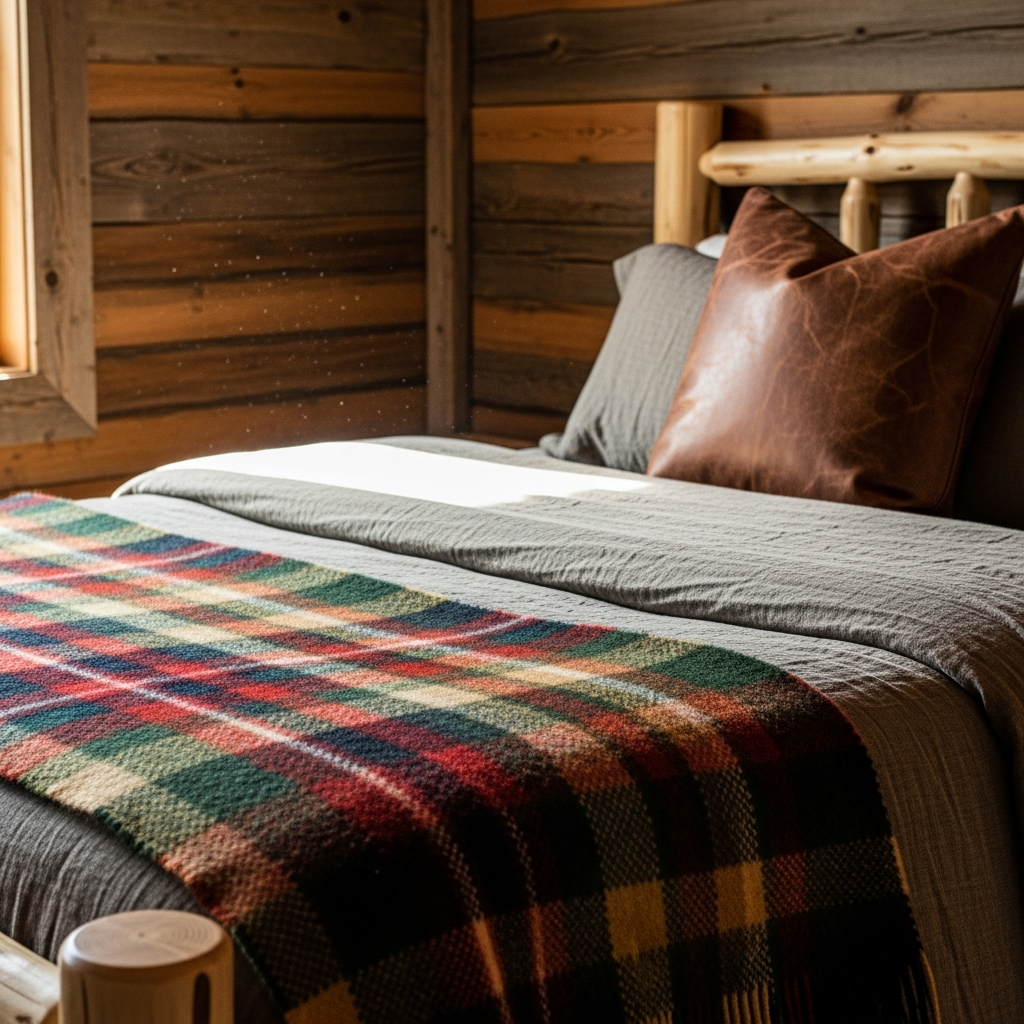
Bedding carries the palette across the biggest surface in the room. Natural linen in warm white or oatmeal makes the cleanest base layer. Buffalo plaid in earth tones — brown and cream, not the bright red and black from the big box store checkout aisle — adds pattern without shouting. A classic plaid wool blanket laid across the foot of the bed works as the single statement textile.
Accent colors throughout the room: deep red, dark forest green, brown leather. All three reference what is outside the window. Skip pastels, skip cool blues, skip anything that reads as coastal or Scandinavian. Those styles are lovely in their own context — they just work against cabin warmth rather than with it.
Lighting: The Most Impactful Rustic Upgrade
If you change one thing in a cabin bedroom, make it the lighting. Nothing transforms a room faster, and nothing says “cabin” more immediately than the right fixture overhead.
An antler chandelier or flush mount is the boldest move. It signals cabin instantly and anchors the ceiling the same way the bed frame anchors the floor. Kalalou and Meyda Tiffany both produce quality antler fixtures. Lodge Craft makes handmade twig and antler lighting with more artisan character — worth the wait if you want something with a story behind it. Edison bulb pendants with exposed filaments bring warmth without the lodge-scale drama, and they work in smaller cabins where an antler chandelier would overwhelm a standard ceiling height. Wall sconces in black iron or oil-rubbed bronze add task lighting with cabin character and do not require overhead wiring.
Skip recessed lighting if you can. It reads as modern and institutional — fine in a kitchen, wrong in a bedroom you want to feel like a retreat. If recessed cans are already in the ceiling, add a central fixture and relegate the recessed lights to dimmed background duty.
For bedside reading, plug-in wall sconces save wiring cost and work in rental cabins where you cannot touch the electrical. And the bulb matters as much as the fixture itself: warm Edison-style bulbs in the 2200-2700K range. Swap in a bright white LED and you will feel like you are trying to sleep in a dentist’s office. I made this mistake once and replaced the bulb the same evening.
Textiles and Layering: Achieving Authentic Cabin Warmth
A cabin bedroom that feels authentic looks like it accumulated its layers over years — not like everything arrived in the same Amazon shipment on a Tuesday. The collected look is the cabin look, and it comes from mixing textures and patterns that share a color family but clearly were not purchased as a set.
Build from the bottom. Neutral linen base sheets in white or oatmeal. A quilt or woven blanket on top in plaid or solid earth tones. A fur or faux-fur throw at the foot — it adds texture and visual weight exactly where the bed needs grounding. For pillows, mix sizes and materials: one solid in leather or canvas, one plaid, one herringbone knit. They should look like they showed up at different times from different stores and different decades.
Underfoot, braided wool rugs in cabin colors — deep red, hunter green, cream, chocolate brown — are the classic pick and they handle foot traffic well. A natural fiber jute rug with a basic weave serves as a quieter base that lets the wood floor show through. Both work. Matching carpet does not.
The layering test: does your bed look like it was arranged for a magazine photograph, or like someone who actually sleeps there pulled the covers up and tossed a blanket across the bottom? The second version is the right answer. Cabin bedrooms should look lived-in, not styled.
Wall Decor and Storage That Looks Like It Belongs
Cabin walls should have character without looking like a sporting goods store detonated in the room. The line between authentic and theme park is thinner than most people realize, and restraint is what keeps you on the right side.
Elements that consistently work: vintage maps of the local area, framed simply in dark wood. A small grouping of black and white wildlife photographs — three is enough, five is too many. A single mounted antler set from a shed find on a hike. A horizontal log shelf holding a few collected objects — a large pine cone, a worn compass, a stack of old paperbacks with faded spines.
For storage that earns its place visually: a cedar blanket chest at the foot of the bed serves double duty — it holds extra quilts and naturally repels moths, and opening it smells like the woods. An antique steamer trunk fills the same role with more visible history. An open shelf in rough-sawn lumber provides display space and light storage without closing the room in.
What does not belong: word-art signs with quotes about living your best life, modern gallery wall arrangements in thin gold frames, and LED neon signs. All three are contemporary design pieces that fight against cabin authenticity every time. The quick test — if you would see it in a newly built apartment downtown, it probably should not hang on a cabin wall.


Stay in the loop
Get the latest rustic cabin world updates delivered to your inbox.