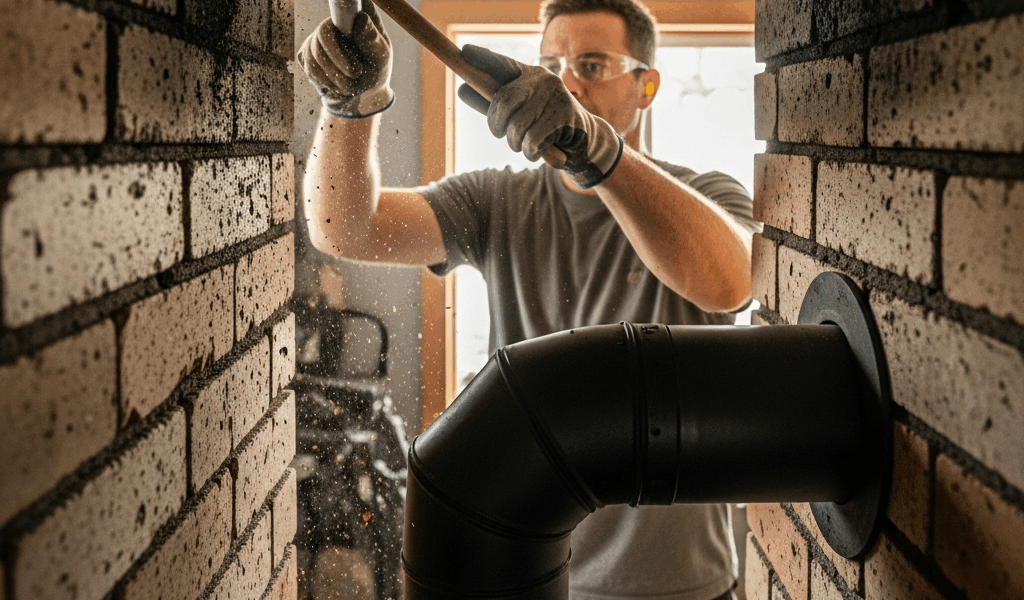
Wood Stove Chimney Creosote — How to Clean It Before It Becomes Dangerous
Wood stove chimney creosote cleaning is one of those maintenance tasks I put off for an embarrassingly long time at my cabin in northern Minnesota. I burned through my first full winter thinking the occasional chimney fire I heard crackling and popping up the flue was just, I don’t know, normal wood stove noise. It was not. What I was hearing was creosote igniting inside the chimney liner — a terrifying thing to understand in hindsight. If you heat your cabin primarily with wood, this article is written for you specifically, not for the suburban homeowner burning three logs on Christmas morning.
The Three Stages of Creosote — Know What You Are Dealing With
Not all creosote is the same, and the difference between Stage 1 and Stage 3 is essentially the difference between a Saturday afternoon project and a phone call to a certified chimney sweep. Before you grab a brush, you need to know what you are actually looking at inside that flue.
Stage 1 — Flaky and Manageable
Stage 1 creosote looks like dusty, flaky black soot. It has a dry, almost powdery texture and will brush off the interior of your flue liner without much resistance. If you shine a flashlight up into your stovepipe and see something that resembles charred cornflakes clinging loosely to the walls, that is Stage 1. This is the version you want to catch it at. A standard wire chimney brush handles it completely. Annual cleaning during this stage keeps things predictable.
Stage 2 — Tar-Like and More Stubborn
Stage 2 creosote is where things get harder and more serious. It has a shiny, tar-like consistency — sometimes described as looking like dried road tar or hardened black foam insulation. It clings. It does not brush off easily. You will need a heavy-duty rotary brush or a drill-powered brush system to make a real dent in it. Some Stage 2 deposits respond to chemical treatments like Anti-Creo-Soot (ACS) spray, which you apply over a few fires to help break down the buildup before mechanical cleaning. Not impossible to DIY, but it is substantially more work.
Stage 3 — Glazed and Genuinely Dangerous
Stage 3 is glazed creosote. It looks almost like black tar that has been baked on — shiny, hard, and sometimes puffed or dripping in shape. This stuff is extremely fuel-rich, highly flammable, and essentially impossible to remove with consumer-grade tools. A chimney fire burning through Stage 3 deposits can reach temperatures exceeding 2,000 degrees Fahrenheit. That will crack a clay tile liner, warp a stainless steel liner, or burn through deteriorated masonry joints. Stop. Do not burn your stove again. Call a professional chimney sweep. This is not a judgment — it is just the reality of what Stage 3 is.
DIY Chimney Cleaning for Stage 1 Creosote
Probably should have opened with this section, honestly, because the tools list is what most people want first. Here is what you need before you start:
- A chimney brush sized precisely to your flue — measure the interior dimensions of your liner, not the outside of the pipe. A 6-inch round brush for a 6-inch round liner, an 8×8 square brush for an 8×8 clay tile flue. I use a Rutland 6-inch wire brush with a set of 5-foot Sooteater fiberglass extension rods.
- Extension rods — at minimum enough to cover the full length of your flue. A single-story cabin with an 18-foot chimney needs four or five 5-foot sections.
- Heavy drop cloths or plastic sheeting for the firebox opening and surrounding floor area.
- A shop vac rated for fine dust — a standard wet/dry shop vac with a HEPA filter works. The DeWalt DXV10P handles creosote dust without clogging constantly.
- Safety glasses and a dust mask rated at least N95.
Cleaning from the Top — Preferred Method
Working from the roof down is the cleaner approach. You drop the brush from the chimney cap opening and work it down through the flue in sections, adding extension rods as you go. The debris falls into the firebox below, which you have sealed off with your drop cloth taped around the stove opening. Once you have brushed the full length, let the dust settle for 15 to 20 minutes before you pull back the drop cloth and shop vac the firebox interior clean.
Get a solid roof anchor point sorted before you climb. Cabin roofs are often steeper and less forgiving than house roofs, and a roof bracket with a ridge hook is worth the $40 investment. Frosted or damp metal roofing is not the time for chimney cleaning — I learned this personally and only avoided a bad fall because my boot caught the cap flashing on the way down.
Cleaning from the Bottom — When You Cannot Get on the Roof
Bottom-up cleaning works but creates significantly more mess. You push the brush up through the firebox and stove collar, working upward through the flue. Seal the room aggressively — creosote dust gets into everything. Cover furniture, close interior doors, and run the shop vac continuously near the firebox opening to create negative pressure if possible. This method is acceptable for tall two-story chimneys in winter conditions where roof access is unsafe.
How to Prevent Creosote from Building Up
The single biggest factor in creosote formation is incomplete combustion. When wood does not burn hot enough to fully combust the volatile gases rising through the flue, those gases cool against the chimney walls and condense into creosote. Everything else follows from that one fact.
Burn Seasoned Hardwood
Seasoned hardwood — meaning wood that has been split and air-dried for at least 12 months, ideally 18 — burns hotter and cleaner than green wood. Oak, maple, ash, and hickory are the gold standard. Green wood contains too much moisture. Burning it is like trying to combust a wet sponge — most of the energy goes toward evaporating water rather than generating heat, and your flue temperatures stay low. Low flue temperatures equal creosote. Simple.
Pine is complicated. I burn pine in my cabin because it is what grows here. Softwoods are not the automatic villain they are often portrayed as — pine creosotes more quickly than hardwood when burned improperly, but dry, well-seasoned pine burned hot is manageable. The problem is pine burned slowly, smoldering overnight, in a cold flue.
Hot Fires Beat Slow Smoldering Burns
This is the key distinction most cabin owners get backwards. A hot, fast fire with the damper open wide produces flue gas temperatures high enough to prevent condensation. A slow, smoldering fire damped way down burns cool, and every hour of that is depositing creosote on your liner walls. For overnight burns, load up with dense hardwood and let it burn at a moderate rate rather than choking the air supply down to near zero. Your wood consumption goes up slightly. Your creosote buildup drops dramatically.
Keep the Damper Position Honest
Fully closed or barely cracked dampers are the enemy. Once a fire is established and your flue is up to temperature, the damper can come down somewhat — but never below the point where you start seeing sluggish, lazy flame behavior. If the flame is rolling and yellow rather than active and orange, you have gone too far.
Cabin-Specific Risks — Remote Location Fire Safety
The EPA estimates that creosote-related chimney fires account for roughly 7% of all residential fires in the United States. That number feels abstract until you think about what it means in a remote cabin context specifically. When my neighbor’s place caught fire two winters ago — a chimney fire that spread to the roof — the nearest fire department took 34 minutes to arrive. The cabin was a total loss before the first truck rolled in.
Remote locations do not get the same fire response times as suburban neighborhoods. That is just the reality. It means the margin for error is smaller, and prevention is not just advisable — it is critical infrastructure for your safety.
Detectors — Non-Negotiable
Every room in a cabin where people sleep or spend significant time needs both a smoke detector and a carbon monoxide detector. Not one combination unit in the hallway. Every room. CO is invisible and odorless, and wood stoves with poor draft can backdraft CO into living spaces without any visible smoke. The Kidde Combination Smoke and CO Detector, model KN-COSM-IBA, runs about $35 and covers both. That is a reasonable investment against the alternative.
Fire Extinguisher Placement
One extinguisher near the stove area, rated at minimum 2A:10B:C. One near the sleeping area exit. Know how to use it — pull, aim, squeeze, sweep. A chimney fire contained to the flue can sometimes be knocked down with a Chimfex chimney fire suppressor stick (about $25 per stick, available at Tractor Supply), which you drop into the firebox to deprive the fire of oxygen. It buys time.
When to Call a Professional vs DIY
Stage 1 creosote is a DIY job. Everything else involves a real conversation about risk tolerance and equipment limitations.
Stage 2 can be DIY with the right rotary cleaning system — the Sooteater drill-powered brush kit costs around $60 and does a reasonable job on moderate Stage 2 deposits — but it often makes sense to bring in a professional for a thorough mechanical cleaning. Stage 3 is simply not a consumer-grade task. Period.
Burned by a surprise Stage 3 discovery one fall, I called in a certified chimney sweep from a CSIA-certified company (Chimney Safety Institute of America certification is the credential to look for) and paid $285 for a full cleaning and inspection. For a cabin chimney with a prefabricated metal liner, professional cleaning runs $150 to $350 depending on your region and the condition of the flue. Masonry chimneys can run higher, especially if inspection reveals cracked tiles or deteriorated mortar joints that need repair.
On frequency — at minimum, clean annually. If you are burning wood as your primary heat source and going through 3 cords or more per season, consider cleaning mid-season as well, around the halfway point of your burn season. Three cords of wood is a reasonable threshold for a second look. That guidance comes directly from the CSIA, and I have found it accurate in practice after four winters of primary wood heat.
The chimney is the one part of a wood heating system that will hurt you if you ignore it. Everything else is relatively forgiving. Do the cleaning. Know what stage you are dealing with. Do not let it get to Stage 3 before you pay attention.

Stay in the loop
Get the latest rustic cabin world updates delivered to your inbox.