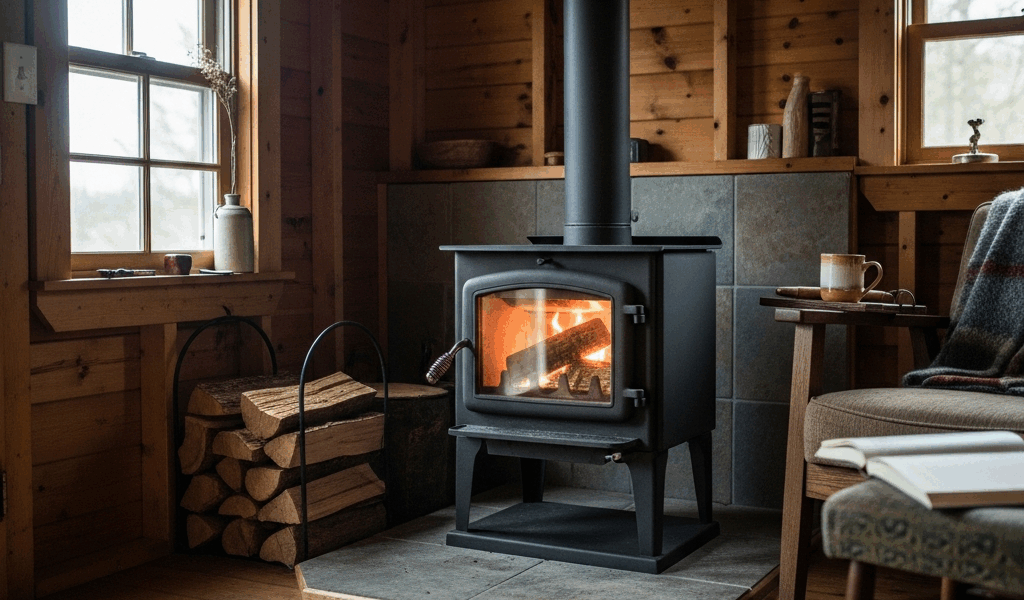
Best Wood Stove for a Small Cabin Under 1,000 Sq Ft
Finding the best wood stove for a small cabin under 1,000 sq ft has evolved with all the marketing noise and spec-sheet jargon flying around. As someone who’s been heating a 740-square-foot off-grid cabin in northern Wisconsin for going on eleven years, I sat down and learned wood stove sizing — mostly the hard way. The first stove I bought was completely wrong for the space. Too big. Burned through a load in four hours flat, turned the place into a sauna, and cost me a cracked flue liner by year three. Avoid the path I took. This guide is what I wish I’d had before I wrote that first check.
This article includes affiliate links. We may earn a commission at no extra cost to you.
How Many BTUs Does Your Cabin Actually Need
Start here. Seriously — Important part first, because it’s the step most cabin owners skip entirely. They fall in love with a stove at a hardware store, buy it, and then wonder why they’re sweating through February or burning through a cord every two weeks.
But what is the baseline rule? In essence, it’s 20 BTUs per square foot. But it’s much more than that — it’s just the starting point for a moderately insulated space in a temperate climate. Cabins aren’t condos. They’re drafty, often built with minimal insulation, and they sit in climates that get genuinely brutal. That 20 BTU number gets complicated fast.
Insulation Multipliers
Modern insulation — think R-13 walls and R-30 attic or better — and you can stay close to that 20 BTU figure. Single-pane windows, uninsulated floors over a crawlspace, walls built before 1980 with nothing added since? Multiply your square footage by 25 to 30 BTUs instead. Old cabins leak heat constantly. The stove has to compensate — there’s no getting around it.
Climate Zone Adjustment
Someone heating a 600-square-foot cabin in coastal Oregon has fundamentally different needs than someone doing the same in northern Minnesota. Add 10–15% to your BTU target if you’re in USDA Hardiness Zones 3–4. Subtract 10% if temperatures rarely drop below 20°F overnight where you are.
Here’s a sizing table built around real-world cabin conditions — not laboratory assumptions:
| Cabin Size | Well-Insulated (BTUs) | Poorly Insulated (BTUs) | Cold Climate Adjustment |
|---|---|---|---|
| 400 sq ft | 8,000 – 10,000 | 10,000 – 14,000 | Add 10–15% |
| 600 sq ft | 12,000 – 14,000 | 15,000 – 18,000 | Add 10–15% |
| 800 sq ft | 16,000 – 20,000 | 20,000 – 24,000 | Add 10–15% |
| 1,000 sq ft | 20,000 – 25,000 | 25,000 – 30,000 | Add 10–15% |
One thing worth saying plainly — bigger is not better with wood stoves. Oversizing forces you to run the stove at low output to avoid cooking everyone out of the cabin, which causes incomplete combustion, creosote buildup, and a shorter stove life. Match the stove to the space. That’s the whole game.
Best Stoves Under 800 Sq Ft — Compact and Efficient
Frustrated by how many vague “best of” lists recycle the same manufacturer copy, I narrowed this category down to three stoves that consistently show up in real-world use — not just spec sheets. Each one has been bought, installed, and reviewed by actual cabin owners. That’s what makes this category endearing to us small-cabin people. There’s real field data behind these picks.
Jøtul F 118
The Jøtul F 118 is a Norwegian-made compact stove — rated at 40,000 BTU max output, though real-world steady-state heat in a small space lands closer to 25,000–30,000 BTUs on a moderate burn. Firebox capacity is 1.7 cubic feet. Burn time on a full load runs 8–10 hours, which matters a lot if you’re not sleeping next to the thing all night. It weighs 287 lbs, so plan your floor reinforcement accordingly. Street price runs $1,800–$2,200 depending on your dealer. Non-catalytic, EPA-certified at 1.3 g/hr particulate emissions, and the cast iron is some of the densest I’ve handled — even heat distribution, holds warmth long after the fire drops.
Vermont Castings Aspen C3
The Aspen C3 is marketed as a hearth stove but installs in cabins constantly. Rated at 42,000 BTUs max, it has a 1.6 cubic foot firebox and a 12-hour burn time claim that I’d put closer to 9–10 hours in honest practice. Price sits at $1,600–$1,900. Non-catalytic design with a secondary air system. One genuine advantage here — the Aspen C3 is physically small. Its footprint is 20.5″ wide by 18.5″ deep, so it fits in tight corners where a Jøtul simply won’t.
Salamander Hobbit
A UK import that apparently doesn’t get nearly enough attention in American cabin circles. The Hobbit is rated at 5kW — roughly 17,000 BTUs — which makes it the right-sized stove for a well-insulated space under 600 square feet rather than a drafty 800-square-foot structure. It weighs only 55 lbs. Price runs around $800–$1,000 imported. The firebox is tiny — 9.5″ wide — which means shorter logs, max 9″, but the steel construction heats up in under 15 minutes. For a weekend cabin that needs to warm fast after a cold Friday night drive in, nothing in this class beats it on response time.
The Pick for Under 800 Sq Ft
The Jøtul F 118 wins this category. The burn time, the build quality, and the emissions performance justify the price difference over the Vermont Castings. The Hobbit might be the best option for very small, well-sealed spaces — as that category requires tight construction and minimal heat loss. That is because the Hobbit’s BTU ceiling will leave you genuinely cold in January if your cabin breathes at all. Most cabins under 800 square feet do.
No matter which stove you choose, a Midwest Hearth magnetic stove pipe thermometer is essential for monitoring flue temperature and keeping your burn in the optimal range — preventing both creosote buildup and overheating.
Best Stoves for 800–1,000 Sq Ft Cabins
Step up in square footage and you need a stove that can maintain temperature over a full night — not just spike heat when you’re actively loading it. The three stoves in this range earn their place for different reasons.
Vermont Castings Encore
The Encore is a catalytic stove rated at 68,000 BTU max output with a 2.4 cubic foot firebox. Burn time with the catalytic combustor engaged runs 8–12 hours on hardwood. Price: $2,400–$2,900. The catalytic combustor extends burn time and cuts particulate output dramatically — Vermont Castings rates it at 2.6 g/hr, well within EPA 2020 standards. The downside is combustor maintenance. You’ll replace it every 6–10 seasons at roughly $80–$120 per replacement. Not a dealbreaker, but it’s a real ongoing cost — one that apparently surprises a lot of first-time catalytic stove owners.
When the time comes for combustor replacement, the Midwest Hearth catalytic combustor for Vermont Castings Defiant and Encore is a Made-in-USA ceramic replacement that fits perfectly and ships fast.
Lopi Endeavor
Non-catalytic. Rated at 75,000 BTU max, 2.5 cubic foot firebox, and a genuine 10-hour burn time on seasoned hardwood. The Endeavor uses Lopi’s FlexBurn technology — lets you run catalytic or non-catalytic mode depending on your wood quality and burn conditions. Clever approach. Price runs $2,800–$3,300. Heavier and more expensive than the Encore, but the FlexBurn system earns its keep in real-world cabin use where your wood supply isn’t always perfectly seasoned.
Blaze King Chinook
The most efficient stove in this roundup. Full stop. The Chinook is a catalytic stove rated at 32,000 BTU average output — not max — which sounds lower until you realize it’s designed to maintain that output for 40+ hours on a single load. That’s a manufacturer claim that cabin owners consistently back up in online forums and reviews. EPA-certified at 0.5 g/hr particulate, it’s among the cleanest stoves on the market. Price: $2,600–$3,100. The thermostat-controlled air intake is the defining feature here — set it, and the stove manages its own burn rate. In a 1,000 sq ft cabin in a genuinely cold climate, the Chinook can run all weekend on a single load of wood.
The Pick for 800–1,000 Sq Ft
Blaze King Chinook. The 40-hour burn claim sounds like marketing copy until you talk to people who actually own them — and then it just sounds like Tuesday. For cabin owners who leave Thursday night and want heat through Monday morning without babysitting the stove, nothing in this price range honestly competes.
EPA Certification and Efficiency — Why It Matters for Cabins
The EPA tightened its residential wood heater standards in 2020 — the threshold is now 2.0 g/hr of particulate matter for certified stoves. Any stove sold new in the U.S. after May 15, 2020 has to meet this standard. Non-certified stoves — including older models still floating around through some dealers — can exceed 10–15 g/hr. That’s not a rounding error. It’s a different category of device entirely.
For cabin owners, this matters for three concrete reasons. First, several states — Washington, Oregon, and Colorado among them — have burn bans triggered by air quality conditions, and non-certified stoves are prohibited from operating during those bans. Run one during a mandatory curtailment and you’re looking at fines starting around $1,000. Second, many states and utilities offer rebates for EPA-certified stove upgrades. Oregon’s program has offered up to $1,500 back. Third — and this is the one people miss — efficiency and emissions are linked. A cleaner-burning stove extracts more heat from the same piece of wood. You’re not just being a good neighbor. You’re getting more from your firewood pile.
Catalytic vs Non-Catalytic
But what is a catalytic stove, really? In essence, it’s a stove that uses a ceramic combustor to ignite gases at lower temperatures — extending burn time and cutting emissions. But it’s much more than that when you’re living with one through a Wisconsin winter. Non-catalytic stoves achieve secondary combustion through baffle systems and preheated secondary air instead. In real-world use: catalytic stoves are more efficient at low burn rates, better for overnight use, but require combustor maintenance. Non-catalytic stoves are simpler — more forgiving of varying wood quality — and still EPA-compliant under 2020 standards. The Blaze King Chinook’s 0.5 g/hr rating versus the Lopi Endeavor’s roughly 1.9 g/hr tells you the real-world efficiency gap between top-tier catalytic and non-catalytic designs.
One key to getting the most from any stove — catalytic or not — is burning properly seasoned wood. A Dr.meter 2-in-1 wood moisture meter takes the guesswork out of firewood readiness. You want readings below 20% before loading — anything higher means more creosote and less heat.
Installation Basics for Cabin Wood Stoves
This is where cabin owners lose money — and occasionally lose their cabins. I say that having watched a neighbor’s outbuilding catch fire from a stove installed with zero clearance consideration. A Tuesday afternoon in September, a total loss by Wednesday morning.
Clearance Requirements
Every stove has manufacturer-specified clearances to combustible materials — typically 36″ from the back and sides for an unshielded stove, reducible with listed heat shields. These aren’t suggestions. Insurance companies use them. So do fire marshals. The Jøtul F 118, for example, requires 18″ side clearance and 16″ rear clearance with its optional shield installed. Read your specific stove’s installation manual before you frame anything — first, you should do this before you even order materials, at least if you want to avoid a very expensive do-over.
Chimney Systems — Double-Wall vs Triple-Wall
For cabin installations, you’ll almost certainly use a factory-built insulated chimney system rather than masonry. While you won’t need a full masonry build, you will need a handful of quality components — and the chimney pipe decision matters more than most people expect. Double-wall insulated pipe — sold as Class A or “all-fuel” — works for most installations. Triple-wall pipe adds another insulation layer and is worth the extra cost — roughly $40–$60 more per 48″ section — in cold climates where outside temperatures routinely drop below 0°F. Cold chimneys draft poorly at startup and collect creosote faster. The extra insulation keeps flue gases hot enough to maintain draft throughout the burn.
Speaking of creosote — regular chimney maintenance is non-negotiable. The Gardus SootEater rotary chimney cleaning system handles the mechanical cleaning, and Rutland Creosote Remover breaks down sticky tar-like buildup between sweeps.
Floor Protection
A non-combustible hearth pad extending at least 18″ in front of the door opening and 8″ on both sides is required under most stove installations. Pre-made hearth pads run $150–$400. Tile over cement board, properly installed, works equally well for less money if you’re building it yourself — honestly, it’s how I did mine and it’s held up through eleven winters without issue.
Professional Install vs DIY
The honest answer — if you’re comfortable with basic carpentry and can follow instructions precisely, a single-story cabin installation with a straight vertical chimney run is a reasonable DIY project. Two-story cabins, offset chimney runs through attic spaces, any installation requiring roof penetration in a complex roofline — those benefit from a certified chimney professional. Installation costs typically run $800–$2,000 depending on complexity. More important than the cost, though — a professionally installed and documented system is required by some insurance carriers to maintain coverage on a cabin structure. Check with your insurer before you cut a single hole in the roof.
After eleven years of heating with wood, the thing I’d tell any new cabin owner is this — the stove decision and the installation decision carry equal weight. Buy the right stove for your square footage, install it correctly, burn seasoned hardwood, and you’ll have a heating system that outlasts everything else in the building. Get either part wrong and you’ll spend the next several seasons trying to undo it.




Stay in the loop
Get the latest rustic cabin world updates delivered to your inbox.