Why Cabins Get Hit Worse Than Regular Homes
Cabin mouse problems have turned into a moving target with all the bad advice flying around. As someone who spent three winters dealing with infestations at our family’s place up north, I figured out how to handle why rodents treat cabins like personal vacation homes. Today, I will share it all with you.
That first January was rough. Found droppings in the silverware drawer, behind the stove, inside a box of pasta I’d left on the shelf. A cabin mouse problem isn’t some freak accident — it’s basically guaranteed unless you understand what you’re working against.
Three things make cabins irresistible. You leave. That’s the big one. A suburban house has people moving through it every day — noise, light, the smell of a cat, the threat of a broom. Your cabin sits dark and silent for weeks. Sometimes months. Mice move in, nest, breed, and establish little highways through your walls before you’ve even thought about coming back. Second thing: log and wood-frame cabins have real gaps. As a cabin settles over decades, logs shift, chinking cracks, foundation vents widen. A mouse fits through a hole the size of a dime. You won’t notice it. Third: food stays behind. That rice you left on the shelf in September? Gone by November. The crackers? Gone. And if you’ve got a woodpile stacked against the cabin wall — which most of us do — you’ve essentially built them a condominium complex with covered parking.
First Thing to Do When You Find Signs of Mice
Arriving to find droppings is never the weekend you had in mind. Panic doesn’t help, though. Here’s what actually works.
Open every window first. Ventilate hard — at least 15 minutes before you touch anything. Mice active for weeks do real damage to air quality in ways you can’t see. Those 15 minutes also keep you from immediately grabbing the vacuum, which is exactly what you should not do.
Steer clear of where I went wrong. I dry-vacuumed the droppings my first year and felt genuinely stupid afterward. Vacuuming aerosolizes particles. Some mice carry hantavirus. You don’t need hantavirus. Instead: spray the droppings lightly with a 10% bleach solution, wait five minutes, wipe everything with paper towels, seal those towels in a bag, and throw it out. Wear disposable gloves — the cheap box of 100 from the hardware store works fine. This takes 20 minutes, not two hours.
While you’re cleaning, map the infestation. Droppings clusters show you exactly where mice are living or traveling. Check behind the stove, under the sink, inside cabinets, along baseboards, and anywhere outside meets inside. Photograph each cluster location on your phone. That map is about to tell you where to place every trap.
How to Actually Get Rid of Them Right Now
Snap traps work. Online forums sometimes dance around this because it sounds brutal — but for remote cabins where you can’t check live traps daily, snap traps are the fastest answer you’ve got.
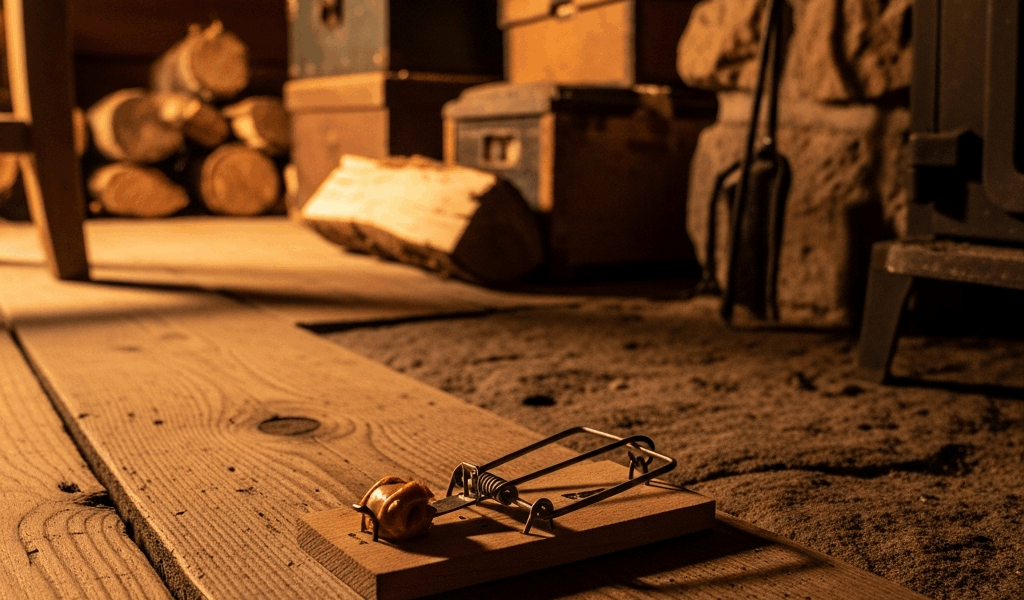
Buy wooden snap traps with the wire bail. Victor brand is standard. A 6-pack runs about $12 at any hardware store — I’ve bought them at True Value, Ace, even a Walmart in a small town outside of Rhinelander. They’re cheap and they do the job. For a moderate infestation, set 8 to 12 traps depending on your square footage and how many clusters you found. Bad infestation — droppings in multiple rooms — go 15 to 20. Sounds like overkill until you remember one female mouse produces 6 to 8 babies per litter. They move fast.
Bait matters more than most people think. Peanut butter wins. Nutella works too — I’m apparently a Jif person and it works for me while cheese never does anything. Forget the cheese entirely. That’s old advice. Smear a small dab directly on the wooden trigger platform. Small. Not a glob. Mice just need to taste it.
Placement is everything — at least if you want results in under 48 hours. This is where your droppings map earns its keep. Place traps along walls, perpendicular to the baseboard. Mice run along walls, not down the center of a room. Put traps behind the stove, under the sink, in pantry corners, near every cluster you photographed. One near the woodpile if it’s against the cabin. Gap under a door? Trap right inside that threshold. Mice are creatures of habit and will use the same routes every single night.
Set traps before you leave for the evening. I know that sounds counterintuitive. But mice are nocturnal and you’ll be more effective not crouching around by flashlight at midnight jumping at shadows. Check traps in the morning. Dispose of catches immediately, reset, keep gloves on. Results usually show up within 48 hours. Catch numbers drop sharply around day three. Most people stop there. Don’t. Keep traps active for at least two weeks — mice that haven’t hit the bait yet are still moving through the walls.
Sealing Your Cabin So They Cannot Come Back
Trapping is emergency management. Sealing is the actual solution. It’s the difference between doing this every single winter and having a cabin that stays clean between visits.
Walk the full exterior perimeter. Look for gaps where pipes enter the foundation, where the chimney meets the roofline, around door frames, under eaves. Log cabins almost always have visible settling cracks that have widened over years. Those are mouse highways. Every one of them.
Use steel wool and expandable foam together. Stuff steel wool tightly into the gap first — mice cannot chew through it — then seal around it with Great Stuff polyurethane expanding foam, about $6 a can at any hardware store. Let it dry, trim flush, caulk the edges. That combination is your reliable defense. Neither material alone is enough. Both together hold up.
Check every door sweep in the cabin. Gaps underneath doors are obvious entry points — rubber door sweeps run $8 to $15 and take ten minutes to install. Foundation vents need hardware cloth screens, 1/4-inch mesh or smaller. Mice cannot squeeze through a 1/4-inch opening. That specific measurement matters.
Move the woodpile. If it’s stacked against the cabin wall, move it at least 15 feet away. Mice nest in wood piles and treat them as staging areas before moving into your walls. At minimum, put hardware cloth or a physical barrier between the pile and the cabin. At best, just move it entirely.
What to Do Before You Leave for the Season
Here’s the part worth saying first. Prevention saves you from finding droppings at all.
Remove all food before you lock up. Everything. Crackers, flour, rice, pasta — even canned goods if the cabin has existing wall damage. Store what stays in hard airtight containers. Leave nothing loose on a shelf. No open pantry, no accessible drawers, nothing sitting out on the counter. Mice will find it. They have time and nothing else to do.
Set 6 to 8 traps with fresh peanut butter before you leave. Leave them active through your absence. They’ll catch opportunistic mice before populations have a chance to explode in the dark while you’re gone.
Seal any new gaps you’ve noticed — right now, not next season. Gaps don’t wait.
Dryer sheets and peppermint-soaked cotton balls placed near entry points add a partial deterrent. Mice dislike the smell. They’re not a solution on their own — spare yourself the wrong turn I took of relying on them alone — but they complement sealed gaps and active traps reasonably well.
Do all of this every time you leave for more than a week. That’s what makes the difference between actually solving the problem and just accepting it the way most seasonal cabin owners eventually do. That’s what makes this whole system worth doing right.



Stay in the loop
Get the latest rustic cabin world updates delivered to your inbox.