Why Propane Heaters Shut Off in Cabins
Cabin propane heat has evolved with all the conflicting advice flying around. Forums tell you it’s the pilot. Your neighbor swears it’s the tank. The propane company wants to sell you a service call. Meanwhile, it’s 11 p.m. on a Friday and you’re standing in a 38-degree cabin in your coat.
As someone who froze through two miserable winters before finally figuring this out, I put in the hours studying why cabin heaters fail. Today, I will share it all with you.
Cabin heaters aren’t like home furnaces — not even close. Sub-zero temps, tanks sitting dormant for months, regulators getting hammered by weather swings from -20 to +60. Three things cause almost every shutdown you’ll ever face: tank pressure problems, a thermocouple that’s dirty or tripped, and a regulator that’s either frozen or dead. Know which one you’re chasing before you touch anything.
Check Your Propane Tank Pressure First
Learn from what tripped me up. My second winter at the cabin, the heater would run maybe twenty minutes and then cut out completely. I spent three weekends convinced it was a pilot issue — that’s what every thread on every forum screamed about. The actual problem was outside my door the entire time: a tank sitting at 20 percent.
But what is propane pressure failure? In essence, it’s when the liquid inside the tank gets too cold to vaporize fast enough. But it’s much more than that. A tank that performs perfectly at 50°F can essentially stop working once temps drop below 20°F. The propane stays liquid. Your regulator can’t pull enough vapor. The heater starves and shuts down. Most cabin owners don’t figure this out until they’ve already torn apart their ignition system for no reason.
Listen to what your heater is actually doing. Clicking, cycling, firing and cutting — that’s usually a pressure or temperature problem with the tank. Dead silence with zero clicking? That points somewhere else, almost always the thermocouple. The sound tells you where to start.
Here’s a field trick that actually works. Run your bare hand slowly down the outside of the tank, top to bottom. Cold metal above. Warmer metal below. The transition point — you’ll feel it clearly — is your fill line. Liquid propane sitting below the midpoint on a night below freezing is your answer right there. No gauge needed.
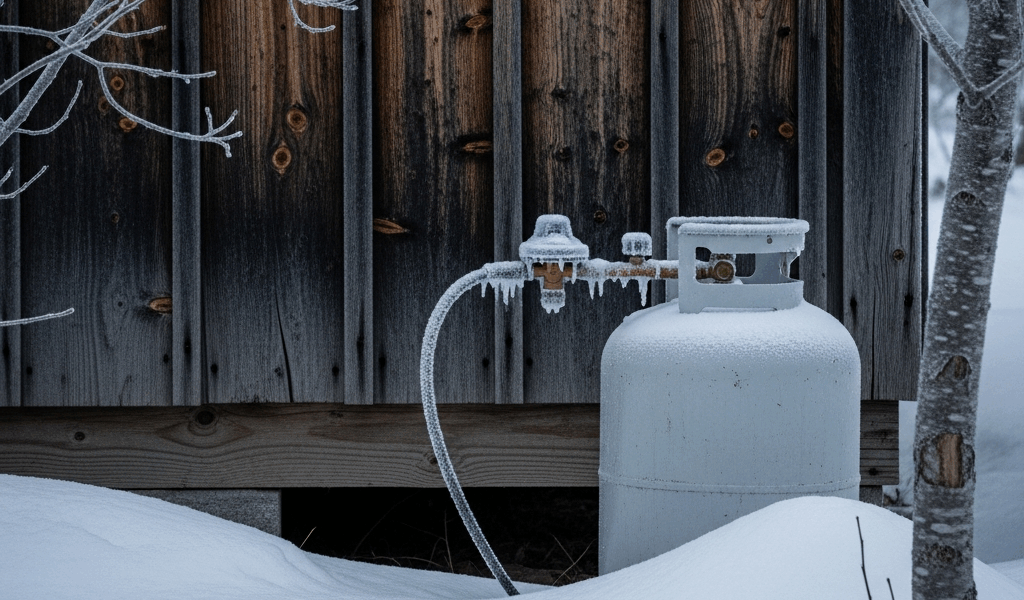
Regulators can also freeze independently, even when the tank is full. You’ll see frost on the regulator body — actual visible frost — and the heater won’t respond at all. Warm it with your bare hand or a cloth for about 90 seconds. Never use a flame or heat gun near any part of a propane system. If the heater fires up after warming, you found it. That’s your whole problem.
Thermocouple Problems and How to Test Them
Frustrated by a second season of mysterious shutoffs, I finally called a propane tech out to the cabin. He walked in, looked at the heater for about two minutes, pointed at a small metal rod near the pilot, and said “that’s your problem.” Charged me $40 for what amounted to thirty seconds of actual work. I’m apparently a slow learner and that $40 lesson works for me while every online forum thread never quite did.
The thermocouple is a safety sensor — roughly the diameter of a drinking straw, a few inches long. It sits in your pilot flame and does exactly one thing: confirms the flame is present and tells the gas valve it’s safe to keep the line open. No signal from the thermocouple means the valve shuts off. That’s intentional. A failed thermocouple won’t let gas flow into an unlit heater. Smart system. Miserable timing when it’s 9 p.m. in January.
The symptom is almost insultingly consistent. Pilot lights. Stays lit for maybe 5 to 10 seconds. Everything cuts off. Pilot goes out. You restart. Same thing happens again. That’s a thermocouple failing its safety check, every single time.
Testing it yourself takes about four minutes. First — does the pilot light at all? If it won’t even ignite, you’re looking at a spark ignitor or gas line issue, which is a different problem entirely. But if it lights and then dies, set the heater to pilot mode and hold the control button down for a full 30 seconds while watching the flame. A working thermocouple holds. A dying one drops the flame the moment you release the button. That’s your test.
Try cleaning before replacing. Turn off the gas, wait five minutes, remove the thermocouple from its fitting — usually finger-tight plus a quarter turn with a small wrench. Use 220-grit or finer steel wool on the tip. Light scrubbing, not aggressive sanding. You’re removing carbon buildup, not shaping the metal. Reposition the tip so it sits directly inside the blue core of the pilot flame — not above it, not beside it, inside it. Relight and test.
If cleaning doesn’t hold, replacement is the actual fix. Thermocouples run $15 to $40 depending on heater model. Desa, Reddy, and Vent-Free all make universal units that fit most cabin heaters. Ten minutes with a wrench. Genuinely one of the more beginner-friendly repairs you can do on any gas appliance.
Regulator Issues That Trip Heater Shutoffs
Regulators are probably the least understood part of the whole propane system. That’s what makes them so frustrating to diagnose for most cabin owners.
But what is a regulator doing exactly? In essence, it’s a pressure reducer — takes the high pressure inside the tank and drops it to the lower working pressure your heater needs. But it’s much more than that. Regulators have a built-in excess-flow shutoff. Open the tank valve too fast — one hard crank instead of a slow turn — and the regulator interprets that pressure spike as a leak. It shuts itself off completely. No clicking, no pilot, no response from anything. The heater acts completely dead.
This happened to me right after a plumber serviced my exterior lines. He cranked the tank valve open hard — standard move for him, total disaster for me. I troubleshot for over an hour before a propane tech on the phone asked me one question: “Did anyone touch that tank valve recently?” The fix took 45 seconds. Close the valve. Wait one full minute. Open it slowly — same energy as unscrewing something fragile. The regulator resets on its own. Heater fires right up.
That’s what makes regulator resets so endearing to us cabin owners — the fix is almost embarrassingly simple once you know it exists.
Worn-out regulators are a different story. Most last 15 to 20 years under normal conditions, but a cabin regulator cycling between -20°F winters and warm summers can fail in 8 to 10 years. Frost accumulation on the body, pressure that drops slowly over days, a heater that won’t respond to any troubleshooting — those are the signs. This new wear pattern developed as more people started using cabins year-round and eventually became the failure mode propane techs see most often in cold-climate properties.
Regulator replacement isn’t DIY work. It requires breaking the gas connection, depressurizing the line safely, and verifying zero leaks after reconnection. Call someone for this one.
When to Call a Propane Tech vs. Fix It Yourself
Worth flagging before going further. The line between a safe DIY fix and a genuinely dangerous mistake is real and worth knowing before you touch anything.
Handle these yourself — no gas release, no combustion work involved:
- Thermocouple cleaning and replacement
- Regulator reset (slow tank valve open and close)
- Tank pressure checks using the hand-temperature trick
- Warming a frozen regulator with your hand or a cloth
Call a professional immediately for anything on this list:
- Gas valve repairs or replacement
- Internal heater component work
- Regulator replacement
- Any repair requiring you to disconnect a gas line
A leak you can’t see or smell is not a theoretical risk. It kills people. That’s not dramatic — it’s just accurate.
While you won’t need a full propane service kit for most of this, you will need a handful of basics before you start: a small adjustable wrench, 220-grit steel wool, a flashlight, and fifteen minutes of patience. First, you should run through this checklist before calling anyone — at least if you want to avoid a $150 service call for a $0 fix.
- Tank level above 25 percent?
- Regulator tested for freezing?
- Thermocouple tested — does the pilot die within 10 seconds of release?
- Tank valve fully open, opened slowly?
A propane tech might be the best option if all four check out clean, as continued shutdowns at that point usually require pressure testing equipment and diagnostic tools most cabin owners don’t carry. That is because worn internal components fail in ways that aren’t visible from the outside — and chasing them without the right tools wastes time you’d rather spend warm.



Stay in the loop
Get the latest rustic cabin world updates delivered to your inbox.