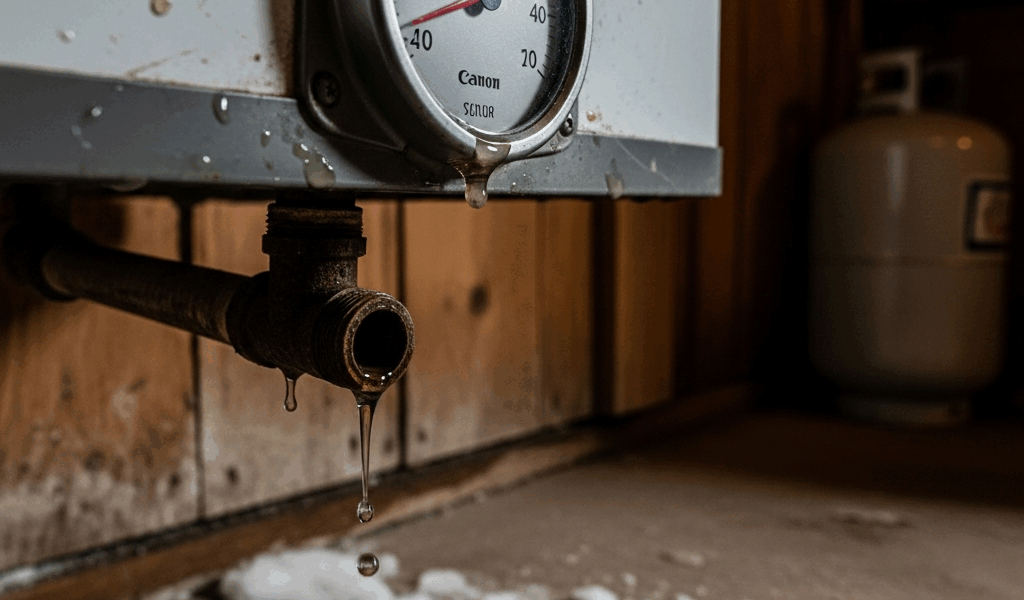
Why Cabin Water Heaters Struggle More Than Home Units
Cabin water heater troubleshooting has changed quite a bit thanks to the generic “just adjust the thermostat” advice flying around. As someone who inherited a beat-up A-frame in the Adirondacks and spent three consecutive weekends ankle-deep in the same problem, I put in the hours studying why cabin units fail differently than suburban ones. Today, I will share it all with you.
Here’s the short version: your suburban neighbor’s water heater problem and yours are not the same animal. Not even close. Well water drags in calcium, magnesium, and silica that city water treatment strips out before it ever reaches the pipes. Propane tanks shed pressure when mountain air drops below freezing. A pipe running 40 feet from tank to shower bleeds heat the entire distance. And the emptiness — most cabins sit dark for months at a stretch, which means mineral deposits calcify faster and pilot lights turn temperamental from disuse.
That’s what makes cabin troubleshooting so endearing to us seasonal property owners. You’re fighting physics and chemistry simultaneously, usually in flannel pants, before coffee. The water heater isn’t undersized because a builder cut corners. It’s undersized because weekend arrival patterns — cold cabin Friday night, everyone wanting scalding showers by Saturday morning — don’t match what these units were designed to handle. Understanding that context matters before you start tightening anything.
Check These Things First Before Anything Else
Before you call anyone or order parts, run through this list. Most cabin water heater problems stop here.
- Thermostat setting — Check the dial on the tank itself, not just the control panel. Someone — maybe you, maybe a guest from August — probably knocked it down to 110°F to save propane. Factory default sits at 120°F. Bump it to 130°F and wait two hours before declaring failure.
- Propane tank level — Walk out to the tank. Press your palm flat against the side. Metal stays cold where liquid propane sits below the surface and turns warmer above it. Warm all the way down? You’re empty or close enough that it doesn’t matter. A full 20-pound tank weighs 37 pounds. Empty is 17 pounds. A fish scale from the garage works fine for checking.
- Pilot light status — Pop the access panel. On older propane units, the pilot flame should be steady blue, roughly the size of a match head. No flame means follow the ignition sequence in your manual. Wind, cabin drafts, and simple age kill pilot lights constantly — this is not a sign of larger failure.
- Tripped breaker — Electric unit or electric ignition? Check the breaker panel. A tripped breaker sits visibly halfway between on and off — it doesn’t snap cleanly to either side. Flip it fully off first, then fully on.
- Water inlet valve — Find the cold-water supply line entering the top of the tank. There’s a shut-off valve on it. Handle parallel to the pipe means open. Perpendicular means closed. Make sure it’s fully open.
Done? Good. Most people find their problem right there and never need the rest of this article.
Sediment Buildup Is the Most Common Cabin Culprit
Frustrated by lukewarm output, a tank making sounds like it’s brewing something alive, and five-minute waits before hot water reaches the showerhead? Sediment is almost certainly your culprit. But what is sediment buildup, exactly? In essence, it’s a layer of minerals — calcium, magnesium, silica — that well water deposits on the bottom of your tank over time. But it’s much more than that.
That mineral layer acts as insulation sitting between the heating element and the actual water you want hot. Your burner fires on schedule. It heats the sediment. The water above it stays lukewarm. The tank works harder, runs longer, and still underdelivers. Classic cabin complaint.
Flushing the tank fixes this. Here’s how to do it without scalding yourself:
- Turn off the water heater at the control panel. Wait 30 minutes. The water inside is genuinely hot.
- Close the cold-water inlet valve — the handle on the line entering the top of the tank.
- Thread a standard garden hose onto the drain valve at the tank’s base. Route the hose outside or to a floor drain.
- Open the drain valve slowly. Let it run until the water coming out is fully clear. On a typical cabin tank, expect 10 to 20 minutes.
- Close the drain valve. Reopen the cold-water inlet valve.
- Let the tank fill completely before switching the heater back on. Running a heating element dry ruins it fast.
The piece that matters most here. Sediment accounts for roughly 60 percent of the cold-water complaints I hear from cabin owners every season. Flush twice a year — once in spring before arrival season, once in fall before you close up — and you’ll sidestep most of what follows in this article.
Frequency depends on your use pattern. Cabin used every other weekend? Twice yearly. Summer-only property? One flush before you arrive. A place that sits untouched for a full year? Flush the moment you get there, before you run any hot water at all. Save yourself the trouble I had — I ran two full showers before flushing and spent the rest of the weekend wondering why the water still smelled like a wet penny.
Low Propane Pressure and Undersized Tanks
Propane pressure drops as temperature drops. At 32°F, a tank delivers meaningfully less volume than it does at 70°F. Add elevation — which compounds the effect — and then stack simultaneous demand on top of that. Shower running, dishwasher going, space heater cycling. The regulator can’t keep pace. Water temperature at the showerhead craters.
I’m apparently a slow learner about propane math, and my 20-pound Coleman-style tank works for me during mild shoulder-season weekends while larger simultaneous loads never really work for it. My first winter stay — a long weekend in January with three people — I assumed six weeks of propane. Gone in three. The tank pressure dropped quietly while I assumed the heater was malfunctioning. Cold showers for two mornings before I figured it out. Learn from what tripped me up.
Check your regulator — it’s the round or oval fitting clamped to the tank outlet. Frost visible on its surface means a frozen regulator, which chokes propane flow regardless of how much fuel remains. Bring the tank inside to a room-temperature space for an hour. That’s the fix. No parts required.
If your cabin sits at elevation or you run propane to multiple appliances at once, an undersized tank is the actual problem. Stepping up from a 20-pound to a 30-pound tank resolves most pressure issues. Some cabin owners run two tanks wired to a simple manifold — one active, one backup — so supply never fully drops out. Installed cost runs $300 to $500 depending on your area. That’s a one-time fix that ends cold-shower surprises for years.
Keep the tank above 20 percent capacity through winter months. Below that threshold during a cold snap, you risk running out at exactly the wrong moment. Check it monthly during heavy-use periods — it takes 30 seconds.
When to Call a Pro and What to Tell Them
Stop troubleshooting yourself if you run into any of these situations:
- Thermocouple failure — The heater ignites but shuts itself off after a few seconds, every time. That’s a thermocouple. A technician should replace it, not a YouTube tutorial at 11pm.
- Anode rod corrosion — Rotten-egg smell from the hot water line means the magnesium anode rod is decomposing. It needs replacement, and its failure signals the tank itself is nearing the end of its useful life.
- Visible cracks or active leaks in the tank body.
- A unit over 10 years old that has never been flushed or inspected.
When you call, lead with this: “My cabin water heater isn’t reaching temperature. I’ve already flushed the tank, confirmed the thermostat setting, verified propane level, and checked that the pilot light is lit and holding. What’s the next step?” You sound competent. You won’t get upsold on a service call that covers things you already ruled out.
Tankless propane heaters might be the best long-term option, as cabin life requires consistent on-demand performance. That is because tankless units carry no standing water to mineralize, no sediment layer to fight, and no standby heat loss burning propane while you sleep. Installed cost runs $1,500 to $3,000 depending on the unit — the Rinnai RU199iN sits at the higher end, the Eccotemp L10 at the lower — and payback on a seasonal property is slower than on a year-round home. The reliability gain, though, is real. So, without further ado, get your flashlight and go check that propane tank first.




Stay in the loop
Get the latest rustic cabin world updates delivered to your inbox.