How to Keep Mice Out of Your Cabin This Winter — What Actually Works
If you’re trying to figure out how to keep mice out of your cabin in winter, I’ll save you the trouble of reading a dozen generic pest control articles written for suburban ranch houses. Cabins are different. I’ve owned a log cabin in northern Wisconsin for eleven years, and I’ve had winters where I walked in come April to absolute devastation — chewed propane lines, a bird’s nest somehow constructed inside my cast iron skillet, and mouse droppings covering every horizontal surface in the kitchen. I’ve also had winters where I found nothing. Zero. The difference wasn’t luck. It was a specific closing process I developed through painful trial and error.
This guide is built around that process. It’s checklist-heavy because that’s what actually works when you’re closing up in October, it’s already getting dark at 5 PM, and you’ve got a four-hour drive home.
Why Cabins Are Especially Vulnerable to Mice
Most pest control content treats mouse prevention like a universal problem. Seal your gaps, store your food, done. That advice isn’t wrong, but it skips over everything that makes a cabin fundamentally different from a house in a subdivision.
Start with construction. Log cabins have chinking — the mortar or sealant material between log courses — and that chinking deteriorates over time. Freeze-thaw cycles crack it. UV exposure dries it out. A gap that wasn’t there three years ago absolutely is now. Mice can compress their bodies through any opening larger than a dime, roughly a quarter inch. Log cabins, especially older ones, can have dozens of those gaps in a single exterior wall.
Then there’s location. Cabins sit in or near actual wilderness. The mouse pressure on a rural cabin in the Northwoods or the Appalachians is categorically higher than on a house in town. There are simply more mice nearby, with fewer competing shelter options.
The biggest factor, though, is vacancy. A house that people live in has constant human activity — noise, smells, movement, heat. Mice are cautious animals. They avoid active human spaces when they have alternatives. An unoccupied cabin from November through March offers everything a mouse wants: warmth, shelter, zero disturbance, and usually some forgotten food. You aren’t there to run them off. Nobody is.
That combination — vulnerable construction, high rural mouse pressure, and months of vacancy — is why cabins get hit so hard. Addressing only one piece of it won’t get you there.
The Fall Closing Checklist — Before You Leave
Probably should have opened with this section, honestly. Everything else is context. This is the actual work.
Food Removal — All of It
The number one mistake cabin owners make is leaving food behind. Not obvious food — most people grab the chips and bread. I mean the food that doesn’t feel like food. A half-used bag of steel-cut oats. The box of hot cocoa packets in the back of the cabinet. Three cans of soup. A bottle of vegetable oil.
Mice can smell calories through packaging. Cardboard is not a barrier. Thin plastic is not a barrier. Even canned goods aren’t entirely safe — mice will chew through paper labels searching for traces of food residue on the outside of cans, and they’ll nest behind canned goods stacked against a wall.
The rule I follow: if it’s organic and it has calories, it leaves the cabin. Everything. The only things I leave are items sealed in thick glass mason jars with metal lids, and even those I wipe down first. Spice jars get pulled. The dog treats get pulled. That emergency granola bar I stuffed in the junk drawer three years ago — pulled.
Cleaning
After food removal, clean every surface where food has ever been. Stovetop, oven, inside the microwave, countertops, the floor under the stove. Grease and crumbs are attractants. Take out the trash completely — don’t just empty the can, take the bag and rinse the can. Wipe down cabinet interiors.
Sealing Gaps
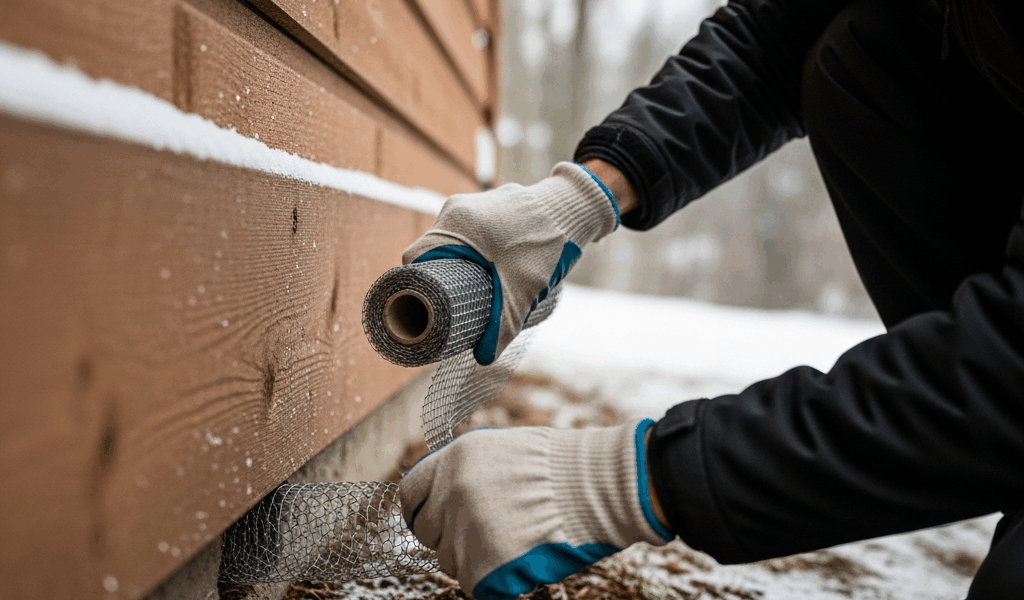
Walk the exterior of the cabin with a tube of DAP Dynaflex 230 caulk and a brick of Stuff It copper mesh (about $18 for a 100-foot roll on Amazon). Any gap larger than a quarter inch gets stuffed with copper mesh first, then sealed over with caulk. Steel wool works too but rusts over time and can fall out — copper mesh holds its shape and doesn’t corrode.
Check your chinking. Run your hand along the log courses from the outside. If you find sections that are crumbly, pulling away from the logs, or have visible cracks, those need to be resealed before you leave. Sashco Log Jam is a reliable chinking product — a five-gallon bucket runs about $85 and lasts multiple seasons. A crack you can slide a playing card into is a crack a mouse can eventually work into a proper entry point.
Snap Traps
Set snap traps before you leave, not poison bait. Poison creates dead mice inside your walls. Dead mice inside your walls create a smell in April that you will not forget. Victor Original snap traps, baited with a pea-sized amount of peanut butter, placed along walls in the kitchen, near the water heater, and under the bathroom sink. I set eight traps for a 900-square-foot cabin. Check and reset them each time you visit, and set them fresh before final closing.
Entry Points Specific to Log Cabins
Generic mouse-proofing articles tell you to check where pipes enter the wall. That’s a start. Log cabins have a longer list.
Where Logs Meet the Foundation
The sill log — the bottom log resting on the foundation — is one of the most common entry points in older cabins. Settlement, wood shrinkage, and foundation movement all create gaps at this junction. Get down low with a flashlight and check the entire perimeter from both inside and outside. Fill any gaps with copper mesh and hydraulic cement or exterior caulk rated for masonry-to-wood contact.
Chimney Penetrations
Where your chimney passes through the roof or an exterior wall, there’s almost always some gap. Mice are excellent climbers. A chase cover on top of the chimney helps, but also look at where the chimney base meets log or framing. That junction flexes with temperature changes and often opens up over years.
Utility Entries
Every place a pipe or wire enters your cabin is a candidate. Plumbing under the kitchen sink, electrical conduit where it comes through the foundation, propane line entry points. These are often sealed when the cabin is built and then gradually loosen. Stuff It copper mesh around the pipe, then seal with caulk or foam. Don’t use expanding foam alone — mice chew through it without much effort.
Doors — Especially on Log Cabins
Standard door sweeps are designed for flat, consistent thresholds. Log cabin floors aren’t always flat. A door sweep that seals perfectly in the middle of the door can have a quarter-inch gap at one corner. I use a brush-style door sweep (the Pemko 315CN is what I have on my front door, about $22 at the hardware store) because the bristles conform to uneven surfaces better than a rigid rubber strip. Check every exterior door. Get on the floor and look at the light coming through when the door is closed.
What Actually Deters Mice — Evidence vs Myths
I’ve tried most of the popular deterrents over the years. Here’s my honest assessment.
Peppermint Oil
Mice don’t like the smell. That part is true. The problem is that peppermint oil dissipates. You douse some cotton balls, put them in the corners, and by week three the scent is gone and you’re not there to replace them. It might slow a mouse down for a night. It does not keep mice out of an unoccupied cabin over a four-month winter. Skip it as a primary strategy.
Ultrasonic Repellers
No credible evidence they work. The FTC has taken action against manufacturers for making unsupported claims. Peer-reviewed studies haven’t found consistent deterrent effects. Don’t buy them.
Dryer Sheets, Mothballs, Irish Spring Soap
Same category as peppermint oil. Temporary at best, useless over a winter vacancy. Mothballs are also toxic to humans and pets and shouldn’t be used inside living spaces.
What Actually Works
Physical barriers. That’s it. Copper mesh, hardware cloth (1/4-inch galvanized, not 1/2-inch — mice go right through 1/2-inch), and caulk. Removing food sources completely. Snap traps that kill mice already inside before you leave. Those three things, done thoroughly, are what actually move the needle. Everything else is wishful thinking sold in a plastic bottle.
Driven by frustration after my third bad winter, I spent a full October weekend doing nothing but sealing entry points with copper mesh and checking every door threshold. That spring I found two dead mice in snap traps and nothing else. Two mice, both caught. That’s the difference between myth and method.
Spring Opening — Signs of Mouse Activity and Cleanup
Open windows immediately when you arrive in spring. Before you do anything else, ventilate the cabin for at least 30 minutes. This matters.
Identifying What You’re Dealing With
Look for droppings first. House mouse droppings are small, about the size of a grain of rice, with pointed ends. Deer mouse droppings are similar but slightly larger. The distinction matters because deer mice are the primary carrier of hantavirus in North America, and hantavirus is serious — it has a mortality rate around 38 percent according to the CDC. Rural cabins in the western and midwestern US have meaningful deer mouse populations.
If you find droppings, do not vacuum them. Do not sweep them dry. The hantavirus is transmitted through aerosolized particles from dried droppings and urine. Wear an N95 mask — not a dust mask, an N95. Wet the area thoroughly with a 10 percent bleach solution (one part bleach, nine parts water) or an EPA-registered disinfectant. Let it soak for five minutes, then wipe up with paper towels and dispose of them in a sealed plastic bag. Same process for any nesting material.
Nesting Material
Mice nest in insulation, stuffed furniture, stored clothing, and any soft material they can find. Check under seat cushions, inside stored sleeping bags, in the gap between your water heater and the wall. A nest that’s been used all winter will contain urine, feces, and potentially young mice. Same wet-cleanup method applies.
When to Call Pest Control
If you open in spring and find evidence of a large infestation — heavy droppings throughout the cabin, multiple nesting sites, damage to wiring or insulation — call a pest control company before sleeping there. Chewed wiring is a fire hazard. Extensive hantavirus contamination in walls or insulation is a health hazard that goes beyond DIY cleanup. A professional assessment is worth the $150 to $300 inspection fee when the situation is that far along.
Most spring openings, if you did the fall closing right, aren’t that dramatic. A few traps, clean surfaces, and you’re grilling by noon. That’s the goal. The fall closing determines what April looks like, every single time.




Stay in the loop
Get the latest rustic cabin world updates delivered to your inbox.